Cut open a disposable diaper and you’ll discover something unexpected: it isn’t simply a soft sheet wrapped around an absorbent pad. Inside is a carefully arranged combination of materials, each designed to handle a different part of a surprisingly complicated job.
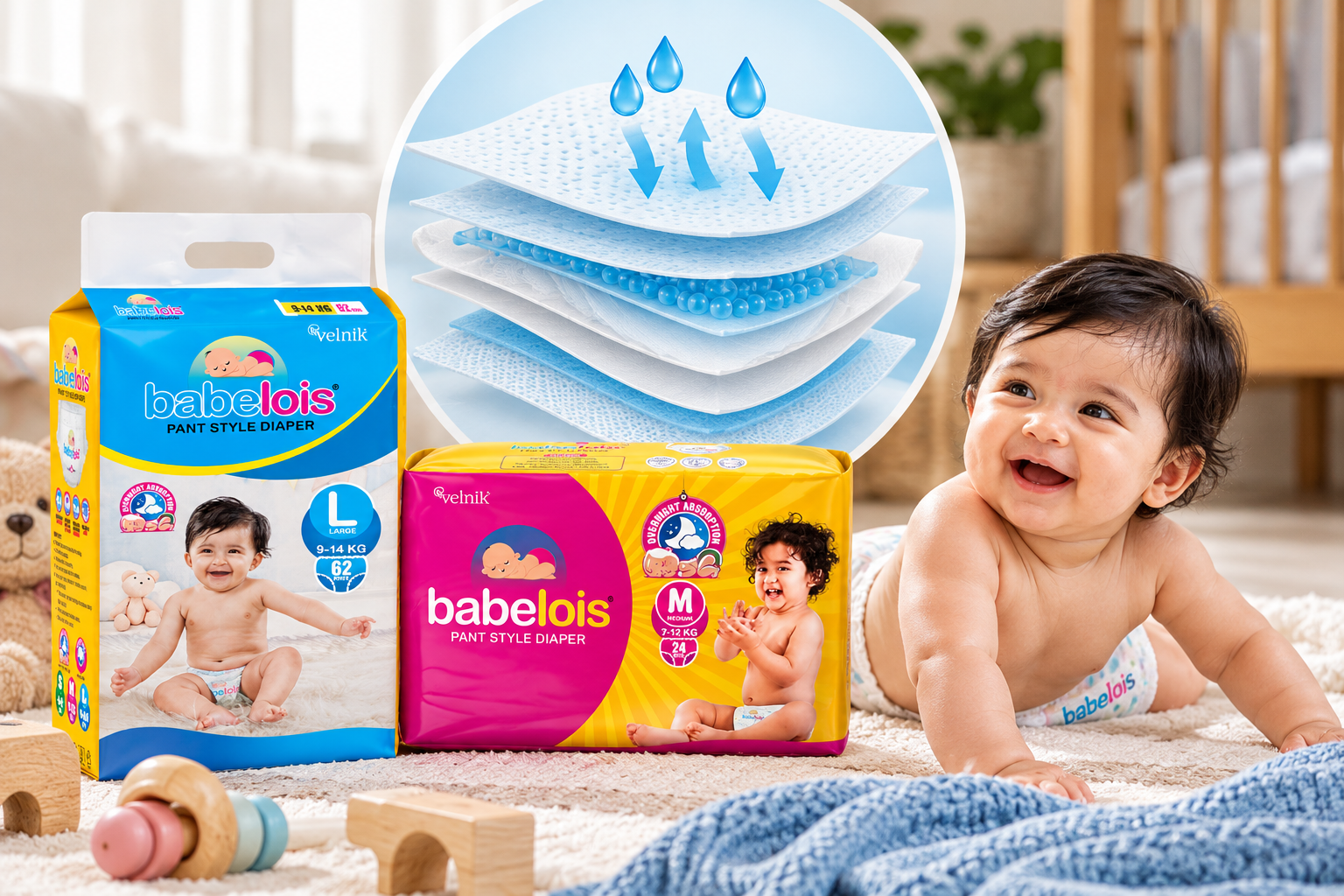
One layer lets liquid pass through. Another helps move it away from the surface. The absorbent core holds it. And the outer covering helps stop it from escaping onto your baby’s clothes.
So why not make the whole diaper out of one super-absorbent material?
Because absorbing liquid is only half the challenge. The diaper also needs to take it in quickly, distribute it efficiently, retain it under pressure and remain comfortable enough for a baby to wear while sleeping, kicking, crawling or exploring.
The clever part of a diaper isn’t one magical material. It’s how the different parts work together.
Let’s take a closer look at the hidden construction behind an everyday baby essential.
Imagine a Drop of Liquid Entering a Diaper
Forget the packaging claims for a moment. Imagine a single drop of liquid landing on the inside surface of a diaper.
Its journey helps explain why the layers are arranged in a particular order.
First stop: The soft surface
The layer touching your baby’s skin is usually called the topsheet. It is designed to let liquid pass through rather than behave like a towel that simply holds everything on its surface.
Why does that matter?
If liquid remained on the surface, your baby’s skin could stay in contact with moisture for longer. A well-designed topsheet helps move liquid towards the layers underneath, although it cannot eliminate all skin moisture or irritation.
Second stop: The traffic controller
Beneath the surface, many diapers have an acquisition and distribution layer. The name sounds technical, but its job is easy to understand: it helps receive liquid and spread it through the absorbent area.
Think of pouring a little water onto one corner of a dry sponge. The water initially reaches one small area, then gradually spreads.
A diaper’s distribution layer helps liquid reach more of the absorbent core instead of concentrating everything in one spot. This can make better use of the available absorbent material.
Third stop: The storage centre
Now the liquid reaches the absorbent core, the part responsible for holding most of it.
Many disposable diapers combine cellulose fibres with a material called a superabsorbent polymer, or SAP. The fibres help absorb and distribute liquid, while the polymer takes in liquid and swells into a gel-like material that retains it.
This is one reason a modern disposable diaper can hold liquid without behaving like a soaked piece of ordinary cloth.
Final stop: The outer barrier
The liquid is now inside the absorbent structure, but the diaper still needs an outer layer to help prevent it from escaping onto clothing.
That is the backsheet. Depending on the design, it may include a liquid-resistant film and a soft outer covering. Some backsheets are designed to allow water vapour to pass through while preventing liquid from leaking out.
Four different jobs. One coordinated system. And all of it happens inside a diaper that looks fairly simple from the outside.
The Strange Science of the Gel Inside a Diaper
Here’s the part that sounds almost like a science experiment.
Some disposable diapers contain tiny amounts of superabsorbent polymer in their absorbent core. When the material is dry, it appears as small particles. When it encounters liquid, it absorbs the liquid and swells into a gel.
The polymer’s structure allows it to retain liquid rather than letting all of it flow freely through the diaper.
But there’s an important distinction: absorbing liquid and retaining liquid under pressure are not exactly the same thing.
Imagine your baby sitting down, rolling over or kicking their legs. The diaper experiences movement and pressure throughout the day. Its absorbent materials need to hold moisture even as the diaper changes shape.
The polymer, cellulose fibres and surrounding layers work together to help manage that challenge.
This doesn’t mean a diaper can absorb an unlimited amount of liquid. Every design has a capacity, and performance varies between products. Once a diaper becomes very full, changing it is still important.
Why Not Put All the Absorbent Material in One Thick Layer?
At first glance, adding more absorbent material might sound like the obvious solution. More material, more absorption, fewer worries. Right?
Not quite.
A diaper must balance several competing needs. It should absorb liquid efficiently without becoming unnecessarily bulky. It should retain moisture while still fitting around a baby’s body. And it needs to distribute liquid through the available absorbent area rather than relying on one small section.
A thick, poorly designed absorbent pad could be uncomfortable between the legs and may not distribute liquid as effectively as a carefully constructed system.
The layers help divide the work:
- The surface allows liquid to pass through.
- The distribution system helps move it to other areas.
- The core stores and retains it.
- The outer barrier helps contain it.
The arrangement matters as much as the materials themselves. A diaper is not simply a contest to see which product can hold the most liquid in a laboratory. It also has to work as a wearable product.
The Parts That Don’t Absorb Anything Still Matter
Here’s a detail that’s easy to miss: not every important diaper component is designed to soak up liquid.
Look at the leg openings. You’ll often find elasticated edges or raised inner cuffs designed to help contain mess and reduce leakage around the thighs.
Look at the waistband. Its job is to help the diaper sit securely on your baby’s body.
Look at the fastening system on a tab-style diaper, or the stretchy waistband on pull-on designs. These features help keep the diaper in position while your baby moves.
Each part contributes to how the diaper performs as a complete product.
For example, pants style diapers for babies use a pull-on design that can make changes easier for parents of wriggly little ones. But their absorbent core still needs to manage moisture, and the leg openings still need to fit properly.
The same principle applies when choosing pant style diapers: the pull-on construction is only one part of the experience. Fit, absorbency and comfortable movement matter too.
A well-designed absorbent core cannot compensate for every problem caused by an unsuitable size or poorly positioned leg gathers.
If the Layers Work So Well, Why Do Diapers Still Leak?
This is where the engineering meets everyday parenting.
A diaper can have multiple layers and still leak. That’s because the layers work within certain limits, and leakage can happen for several different reasons.
The absorbent core may be full. Once its capacity is reached, additional liquid may escape.
The diaper may not fit correctly. Gaps around the thighs or waist can give liquid a way out before the absorbent core can contain it.
The liquid may arrive faster than it can be absorbed and distributed. The acquisition layer helps manage incoming liquid, but the entire system still has practical limits.
The diaper may have shifted. Crawling, kicking and other movements can affect its position, especially if the size or fit isn’t suitable.
When comparing leak proof diapers, look beyond the phrase itself. No diaper can guarantee zero leaks in every situation. A good fit, appropriate absorbency and timely changes remain essential.
If leaks happen repeatedly, check the size, positioning and leg gathers before assuming the internal layers are the only problem.
What About Diapers for Newborns? Are Their Layers Different?
Newborn diapers have the same fundamental challenge: manage liquid, help keep it away from the skin and fit a very small body comfortably.
When choosing diapers for newborn baby, look for a size suited to your baby’s weight and a design that sits comfortably around the waist and thighs. Some newborn products include a shaped or lowered front to help avoid contact with the healing umbilical stump.
The precise materials and number of layers vary by manufacturer and product. Not every diaper uses exactly the same construction, and some designs combine functions into fewer layers.
That is worth remembering when reading product descriptions. A diaper advertised as having a particular number of layers isn’t automatically better than one with fewer. What matters is how effectively the overall design performs its intended jobs.
Does More Technology Mean a Better Diaper?
Not necessarily.
One diaper might emphasise a thin absorbent core. Another might focus on a soft surface, stretchy fit or additional leakage barriers. Different designs can prioritise different combinations of features.
Rather than counting layers or choosing the product with the longest list of technical terms, consider what matters in daily use:
- Does the diaper fit your baby’s body correctly?
- Does it absorb and retain moisture effectively?
- Do the leg openings help contain leaks?
- Does your baby seem comfortable wearing it?
- Is it suitable for your baby’s current size and stage?
A diaper with sophisticated internal materials still needs to fit properly. Equally, a diaper that looks simple from the outside may contain a carefully engineered absorbent system.
The best choice is the one that combines suitable performance with comfort and a reliable fit for your baby.
One Small Product, Several Jobs Happening at Once
A disposable diaper may look like a single piece of material, but its construction is closer to a team in which every member has a different responsibility.
The topsheet helps liquid pass through. The distribution layer helps move it. The absorbent core stores it. The outer barrier helps contain it. Elastic edges and waistbands help the whole system stay in place.
Remove or redesign one component, and the performance of the entire product may change.
The next time you fasten a fresh diaper, remember that the softness you can feel is only one part of its design. The real work happens beneath the surface, where materials with different properties work together to manage liquid, support fit and help keep your baby’s clothes dry.
A diaper isn’t clever because it has lots of layers. It’s clever when every layer has a purpose—and all those purposes work together.