There is a strange period in babyhood when your little one seems to be changing faster than your routine can keep up.
At six months, you may still be feeding, carrying and dressing your baby for almost everything. A few months later, that same baby might be crawling towards the kitchen, grabbing food from your plate, pulling themselves up against the sofa and becoming deeply offended when you take away something they were never supposed to have in the first place.
Somewhere between six and eighteen months, babies begin moving from being cared for almost entirely by their parents to becoming surprisingly active participants in their own little world. They want to touch, taste, move, choose and explore, even though they still need plenty of help along the way.
That is what makes this stage so wonderfully messy.
The changes are not limited to milestones. Everyday routines start changing too, including mealtimes, dressing, sleeping, playing and diaper changes. What worked beautifully a few months ago may suddenly feel less convenient simply because your baby has become a very different kind of baby.
In This Article
- Welcome to the Messy Middle
- When Food Stops Staying on the High Chair
- The House Becomes One Giant Playground
- When Getting Dressed Becomes a Team Sport
- The Diaper Routine Starts Changing Too
- Why Outings Feel Completely Different Now
- When Your Baby Wants to Do Things “By Myself”
- Making Sense of This Very Messy Stage
1. Welcome to the Messy Middle
The six-to-eighteen-month period does not really feel like one stage.
It is more like several stages happening at once.
Your baby may still want to be cuddled like a tiny newborn in the morning and then spend the afternoon trying to climb onto the sofa. They may happily let you feed them one day and grab the spoon from your hand the next. They can be completely dependent on you while also making it very clear that they have their own ideas.
This mixture of dependence and independence is what makes the period so unpredictable.
It also explains why parents often find themselves changing routines that seemed perfectly settled before. The challenge is not that something has suddenly gone wrong. Your baby has simply started doing more, and every new ability creates a small ripple through the rest of the day.
Even something as ordinary as getting dressed can require a different approach when your baby no longer considers sitting quietly an interesting activity.
2. When Food Stops Staying on the High Chair
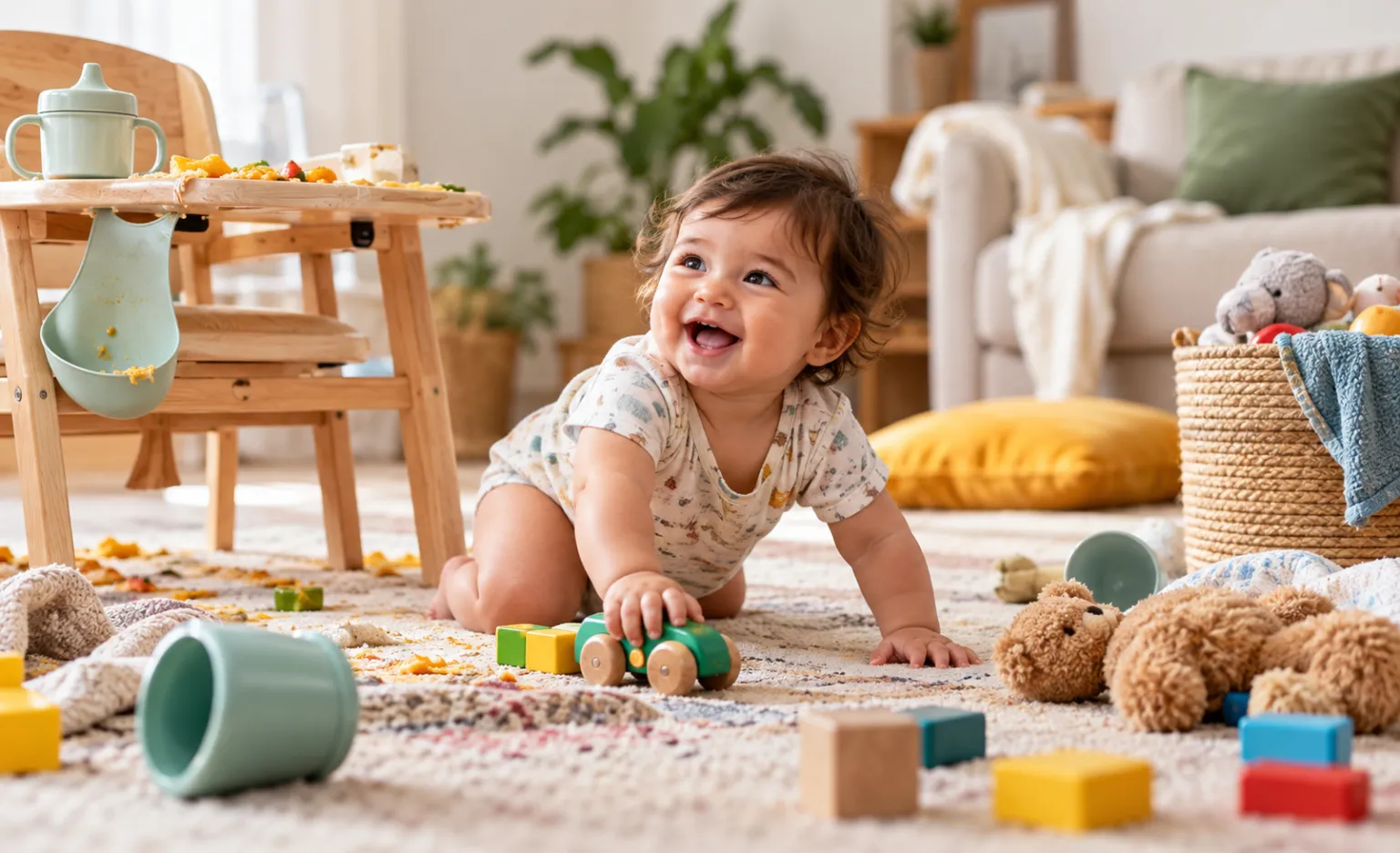
One of the great mysteries of this stage is how a small amount of food can somehow reach every surface within a three-metre radius.
The spoon goes down. The bowl gets investigated. Something ends up on the tray, something ends up on the floor and something you cannot identify appears on your baby’s sleeve.
Mealtimes become less about simply feeding your baby and more about letting them explore food, textures and the idea of doing things themselves.
That exploration inevitably makes the rest of the routine messier. Clothes need changing more often, hands need cleaning, and sometimes a perfectly good diaper change needs to happen immediately after a meal because waiting is simply not an option.
This is one reason the middle months can make parents appreciate convenience in places they never thought much about before. When several small tasks are happening one after another, anything that keeps the routine moving can make the entire day feel easier.
3. The House Becomes One Giant Playground
At the beginning of this stage, your baby may be content playing with a toy placed directly in front of them.
Then they discover movement.
Suddenly, the toy across the room is more interesting. The bottom shelf is fascinating. A cardboard box becomes entertainment. The cushion you carefully placed on the sofa is apparently an invitation to climb.
The house that once felt like a collection of rooms gradually becomes a map of places your baby wants to investigate.
This is when parents start noticing that babies do not simply move from one milestone to another. They combine everything they have learned. A baby who has learned to crawl may start pulling up. A baby who can stand may begin cruising along furniture. Before long, they are experimenting with how quickly they can get from one place to another.
That constant movement changes everyday care because your baby is no longer spending most of their time in one predictable position.
4. When Getting Dressed Becomes a Team Sport
Getting a baby dressed sounds simple until the baby decides that the armhole is actually a tunnel and your hands are something worth grabbing.
At this age, dressing often happens alongside movement. Your baby may turn around while you are trying to put on a top, crawl away while you are reaching for trousers or decide that the clean outfit you just prepared is the perfect place to wipe their hands.
It can be tempting to think that you simply need more patience, but sometimes the easier solution is to make routines better suited to the stage your baby is in.
The same principle applies to diapering. A style that worked comfortably when your baby spent most of the day lying down may become less convenient once they are constantly sitting, crawling, standing and trying to move away.
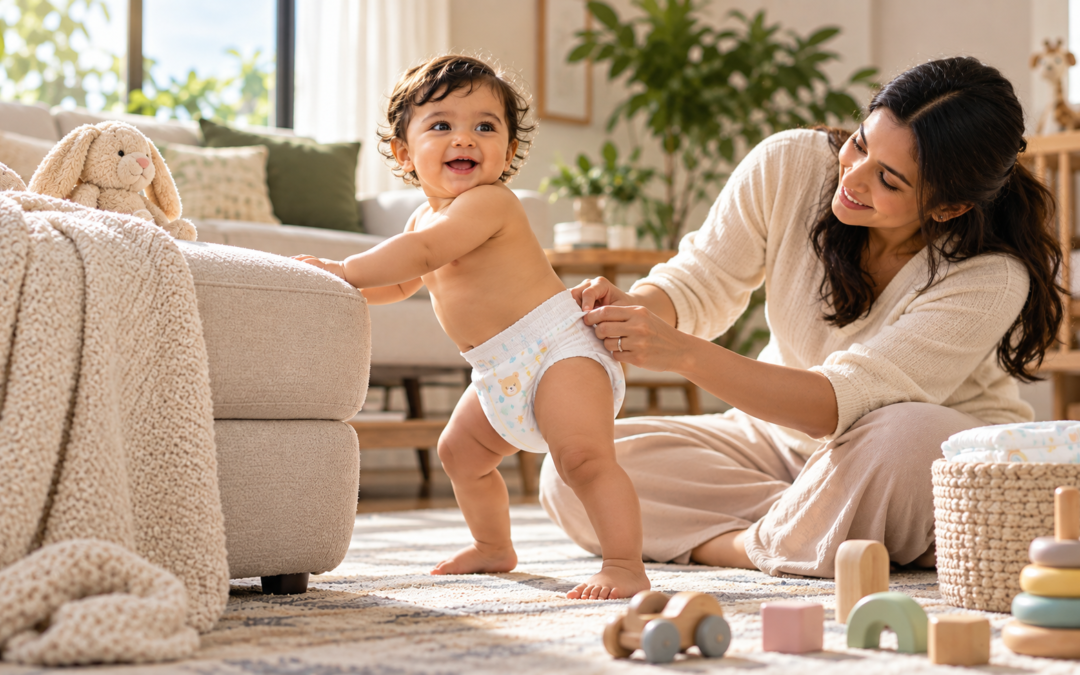
This is where pant style diapers can become useful for some families. Their pull-on design fits more naturally into a stage when getting a baby changed increasingly feels like getting a very determined little person ready for the next activity.
5. The Diaper Routine Starts Changing Too
The interesting thing about diapering during these months is that the diaper itself may not be the first thing that changes.
Your baby changes first.
At six months, you may still have a fairly predictable changing routine. By twelve months, your baby may want to sit up halfway through the process, reach for the wipes or crawl away as soon as they realise what is happening.
The routine has become less about placing a baby somewhere and completing a task, and more about working with a child who is increasingly aware of what you are doing.
This is also why the diapering needs of this stage can feel very different from those of the early months. Diapers for newborn baby are used during a period when babies are generally far more dependent on adults for positioning and movement. As babies grow, parents naturally begin looking for options that fit better with the way their child behaves now.
For some families, that can mean introducing pants style diapers for babies when pull-on convenience starts making more sense for their everyday routine.
It is not about reaching a particular age and automatically changing diaper styles. It is about recognising when your baby’s behaviour has changed enough to make the old routine less practical.
6. Why Outings Feel Completely Different Now
Leaving the house with a young baby requires preparation.
Leaving the house with a mobile baby requires preparation, flexibility and a willingness to accept that the plan may not survive the first fifteen minutes.
A short visit can suddenly become much longer because your baby is fascinated by everything around them. A trip to the park becomes an opportunity to crawl through grass. A family lunch becomes an extended exploration of the chair, table and everything underneath it.
Parents often become more aware of diaper performance during this stage because the day is no longer built around long periods of quiet rest.
A diaper needs to remain comfortable while the baby moves around, sits, crawls and plays. Parents may also specifically look for leak proof diapers, particularly when a busy day means changes may not happen at exactly the planned moment.
But performance is only part of the equation. Convenience matters too, because changing a wriggly baby in an unfamiliar place is very different from changing a sleepy baby at home.
7. When Your Baby Wants to Do Things “By Myself”
They cannot say it yet, but many babies begin communicating the idea surprisingly early.
They reach for the spoon.
They grab the cup.
They try to put on their own sock.
They insist on holding whatever you are holding.
They may not actually be capable of doing these things independently, but the desire to participate is unmistakable.
This is one of the most important shifts during the messy middle. Your baby is slowly moving from being someone you simply care for to someone who wants to take part in everyday routines.
That does not mean every routine needs to become a lesson in independence. Sometimes it simply means allowing your baby to participate where appropriate while keeping the practical parts manageable for you.
Even diapering can eventually become part of this transition. A pull-on style can look more familiar to a child as they begin to understand that clothes go on their body and that everyday routines have a beginning and an end.
The important thing is not to rush independence. Babies have plenty of time to grow into it.
8. Making Sense of This Very Messy Stage
The six-to-eighteen-month period can make parents feel as though the rules keep changing.
Just when you establish a reliable routine, your baby learns something new.
A new movement changes playtime. New foods change mealtimes. Increased mobility changes dressing. Longer outings change what you carry in your bag. And greater awareness changes the way your baby responds to everyday care.
That is why this stage can feel so messy, but also so rewarding.
Instead of trying to keep every routine exactly as it was, it can help to look at what your baby needs now. If they are moving more, routines may need to allow more movement. If they want to participate, give them small opportunities to do so. If a particular task has become unnecessarily difficult, look for a simpler way to handle it.
You do not have to reorganise your entire life every time your baby reaches a new milestone. Sometimes one small change is enough.
Takeaway
The “messy middle” is messy precisely because your baby is no longer quite as tiny and dependent as they once were, but they are nowhere near ready to manage everything themselves.
They are learning how to move through the world while you are learning how to keep up with them.
That is why the months between six and eighteen can change so much about everyday life. Mealtimes become experiments, the living room becomes an adventure zone, getting dressed becomes more interactive, and diaper changes gradually need to work around a baby who has discovered that movement is much more fun than staying still.
There is no perfect routine for this stage, and there does not need to be one. The goal is simply to notice what has changed, make small adjustments where they help, and give yourself permission to laugh when the food ends up on the floor again.
Because this messy middle is not a problem to solve. It is the part of babyhood where your little one is becoming much more of their own person.