
You know that moment when you wake up before your baby does and immediately check the clock?
For a second, you don’t understand what has happened. Then it hits you: your baby is still asleep.
The nap that was supposed to last forty minutes has somehow crossed the one-hour mark. The usual nighttime wake-up hasn’t happened yet. The house is quiet, and for once, nobody is calling your name from another room.
You should probably enjoy it.
Instead, you start wondering about the diaper.
Is it still comfortable? Has your baby been asleep too long? Should you wake them? What if they wake up and the diaper has leaked everywhere?
This is one of those parenting situations nobody really prepares you for. You can be desperate for your baby to sleep a little longer and still find yourself standing outside the room wondering whether an extra hour of sleep is going to create a laundry problem.
The good news is that a longer sleep doesn’t automatically mean a diaper disaster. What matters is what the diaper is designed to handle, how your baby sleeps and whether there are signs that they actually need a change.
In This Article
- When “Just a Short Nap” Turns Into Something Much Longer
- What Is Your Baby’s Diaper Doing While They Sleep?
- Why the Clock Isn’t the Whole Story
- The Difference Between Wet and Uncomfortable
- When an Extra Hour Becomes an Overnight Stretch
- Why Your Baby’s Position Can Change the Situation
- When Growing Babies Change the Diaper Game
- Should You Really Wake a Sleeping Baby for a Diaper Change?
1. When “Just a Short Nap” Turns Into Something Much Longer
Parents quickly become familiar with their baby’s usual sleep patterns, even when those patterns are anything but predictable.
You know roughly when a nap tends to happen, how long your baby usually sleeps and the point at which you start wondering whether they are ever going to wake up. Then, every so often, your baby completely ignores the usual schedule and gives you an unexpected stretch of sleep.
It can feel wonderful.
It can also make you suspicious.
You might peek into the room because the silence feels almost too good to be true, only to find your baby sleeping peacefully with no interest whatsoever in your carefully planned timetable.
This is where the diaper question usually appears.
If your baby is sleeping comfortably and there is no specific reason you have been advised to wake them, there may be no need to turn an unusually good nap into an unnecessary interruption. Babies have individual sleep and feeding patterns, particularly during the first year, so there isn’t one universal number of hours that automatically means a diaper must be changed.
Sometimes, the unexpected extra hour really is just an extra hour of sleep.
And yes, you are allowed to enjoy it.
2. What Is Your Baby’s Diaper Doing While They Sleep?
While your baby is having their peaceful little break, the diaper isn’t simply sitting there waiting for you to remember it exists.
When your baby wets, moisture passes through the inner layer and moves towards the absorbent core. The materials inside are designed to take in and retain that moisture rather than leaving it sitting directly against the skin.
That becomes particularly useful during sleep because nobody is checking the diaper every few minutes.
A well-designed diaper has to cope with a baby who is doing absolutely nothing to help it. Your baby might remain curled up in one position, stretch their legs, roll slightly or sleep through several wettings without giving you the slightest indication that anything has happened.
The diaper’s job is to manage that moisture while your baby carries on sleeping.
That is why the question isn’t simply, “How long has the diaper been on?”
A more useful question is whether the diaper is still comfortable, contained and suited to your baby’s needs.
3. Why the Clock Isn’t the Whole Story
It is tempting to create a mental countdown.
Two hours?
Probably fine.
Three hours?
Maybe time for a change.
Four hours?
Panic.
Real life doesn’t work quite that neatly.
A baby’s wetness depends on many things, including their feeding pattern, how much they drink and their individual routine. Two babies who sleep for the same amount of time won’t necessarily have identical diaper situations when they wake.
That is why looking only at the clock can be misleading.
Instead, think about what you can actually observe. If your baby is sleeping comfortably, there is no visible leakage and there isn’t another reason to wake them, the extra sleep itself isn’t necessarily a reason to intervene.
On the other hand, if the diaper is leaking, your baby appears uncomfortable or you already know from experience that a particular sleep period tends to result in a very full diaper, the situation is different.
Parenting often works this way.
The clock gives you information.
Your baby gives you the context.
4. The Difference Between Wet and Uncomfortable
This is probably one of the easiest details to overlook.
A diaper can contain urine without your baby immediately becoming uncomfortable. Modern diapers are designed to move moisture away from the surface and retain it within the absorbent material, which is why the inside of a used diaper doesn’t necessarily feel like a wet cloth.
That distinction matters during a long nap.
Your baby isn’t necessarily lying against a pool of moisture simply because they haven’t been changed for another hour. The diaper is designed to manage the liquid inside it while the surface remains comparatively dry.
Of course, no diaper has unlimited capacity, and a baby shouldn’t be left in a soiled diaper simply because they happen to be sleeping. If there is a bowel movement, visible leakage or obvious discomfort, that takes priority over preserving the nap.
For everyday wetness, however, the situation is not always as urgent as a tired parent might imagine at three in the morning.
Sometimes the diaper is doing exactly what you bought it to do.
5. When an Extra Hour Becomes an Overnight Stretch
The “just one more hour” question becomes much more interesting at night.
You may have gone to bed expecting your baby to wake at a familiar time, only to realise that the usual wake-up has come and gone. You check the clock, check the baby and then start calculating how long the diaper has already been on.
The temptation is to wake the baby simply because the schedule in your head says you should.
But nighttime diapering is often about balancing comfort with keeping sleep as undisturbed as reasonably possible. If your baby does need a change, keeping the room dim and the interaction quiet can help prevent the change from becoming a full wake-up event.
And when your baby is sleeping comfortably, there is something to be said for letting a peaceful stretch continue rather than creating a new problem by waking them unnecessarily.
For babies with specific feeding, growth or medical requirements, however, those individual instructions should always take priority over general diapering advice.
Every baby has their own situation.
There is no universal “three-hour rule” hiding somewhere in the parenting handbook.
6. Why Your Baby’s Position Can Change the Situation
Babies have a talent for sleeping in positions that would make most adults uncomfortable.
They curl their legs up, turn their heads to one side and somehow manage to end up at an angle you would never choose for yourself.
Their sleeping position can also affect how a diaper handles moisture.
During a long stretch of sleep, your baby’s body may remain in roughly the same position for an extended period. The diaper has to continue absorbing and containing moisture while pressure is being applied to particular areas.
This is one reason fit becomes important, particularly as babies grow.
A diaper that sits comfortably around the waist and legs can move with your baby rather than creating gaps where moisture may escape. If you regularly wake up to damp clothes or bedding, the issue may not simply be that your baby slept “too long.” The size, fit, positioning or absorbency may need another look.
Sometimes the problem isn’t the extra hour.
It is what the diaper was being asked to do during that hour.
7. When Growing Babies Change the Diaper Game
The extra-hour challenge looks different at different stages.
A newborn may wake frequently because they need to feed, which means long uninterrupted stretches of sleep may be less common. During this stage, diapers for newborn baby need to work around a routine that can change several times throughout the day and night.
As your baby grows, sleep can become more predictable, but movement starts entering the picture. A baby who once slept peacefully in one position may later spend the night rolling, kicking and changing position.
Eventually, daytime diaper changes can become a completely different experience too.
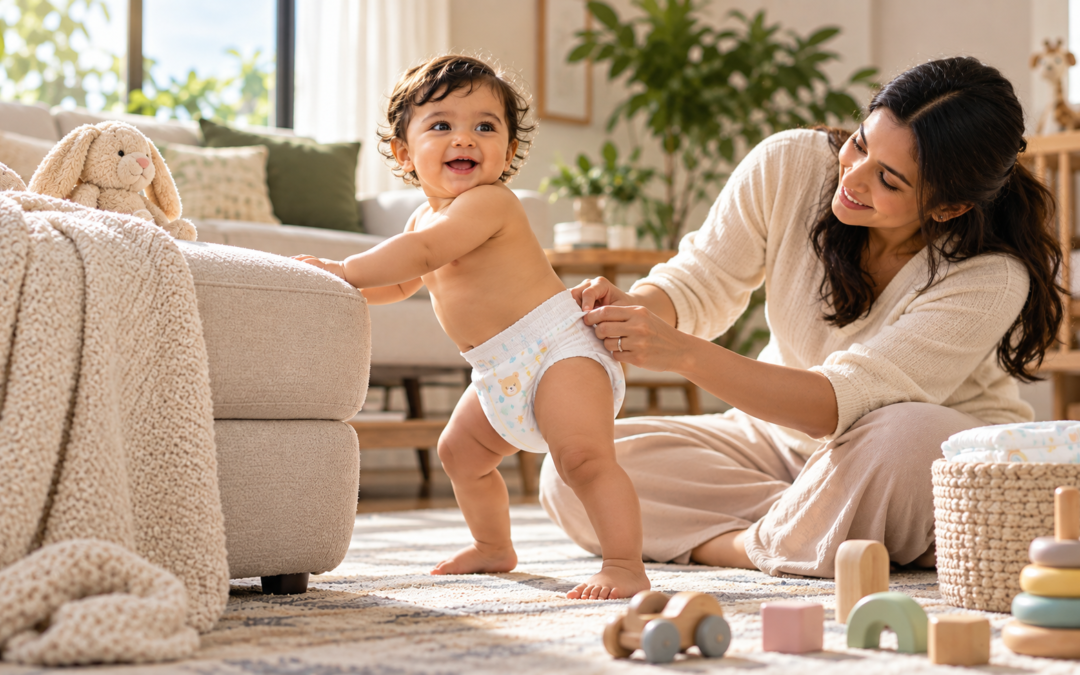
Once your baby becomes more active, some parents find pant style diapers easier to manage because getting a diaper on a baby who would rather stand, crawl or explore can be much less frustrating with a pull-on style.
For families with active little ones, pants style diapers for babies may also fit more naturally into this stage, particularly when diaper changes are no longer guaranteed to happen with your baby lying quietly on a changing mat.
The first year keeps changing the question.
At first, you’re asking, “How do I change this tiny baby?”
Later, you’re asking, “How do I change this tiny person who is actively trying to leave?”
8. Should You Really Wake a Sleeping Baby for a Diaper Change?
This is where parents often want a simple yes or no, but real life is rarely that tidy.
If your baby has been advised to wake for feeds or has specific medical or growth-related needs, follow that guidance rather than relying on a general rule. If your baby has had a bowel movement, is visibly uncomfortable or has leaked through the diaper, a change may also be necessary regardless of how peacefully they are sleeping.
But if your baby is simply having an unexpectedly long stretch of sleep and the diaper is doing its job, waking them solely because the clock has moved past your expected change time may not always be necessary.
This is also where choosing leak proof diapers can make the longer stretches feel less stressful, because containment becomes especially important when you are hoping everyone can stay asleep.
The goal isn’t to see how long a baby can go without a diaper change.
It is to recognise when the diaper is still doing its job and when your baby is actually telling you that something needs attention.
Takeaway
The unexpected extra hour of sleep can make parents feel strangely conflicted.
You desperately want your baby to keep sleeping, but your brain has already started listing all the things that could go wrong while they do.
The diaper doesn’t have to be the reason you wake a peacefully sleeping baby every time the nap runs longer than expected. What matters is your baby’s individual needs, whether the diaper is containing moisture comfortably, and whether there is any sign that a change is actually needed.
And if everything is fine?
Enjoy the quiet.
Make the coffee you never get to drink while it’s hot. Sit down without listening for the next little sound from the monitor. Take the extra hour as the small gift it is.
Because babies have a remarkable habit of making sleep unpredictable.
When they unexpectedly give you more of it, sometimes the best thing to do is let them—and let the diaper quietly earn its place in the routine.