There is a strange little rule of parenting: the moment you need your baby to stay still, they suddenly discover they have legs.
You place them on the changing mat, and everything looks promising. The clean diaper is ready. The wipes are within reach. You are feeling unusually organised.
Then comes the kick.
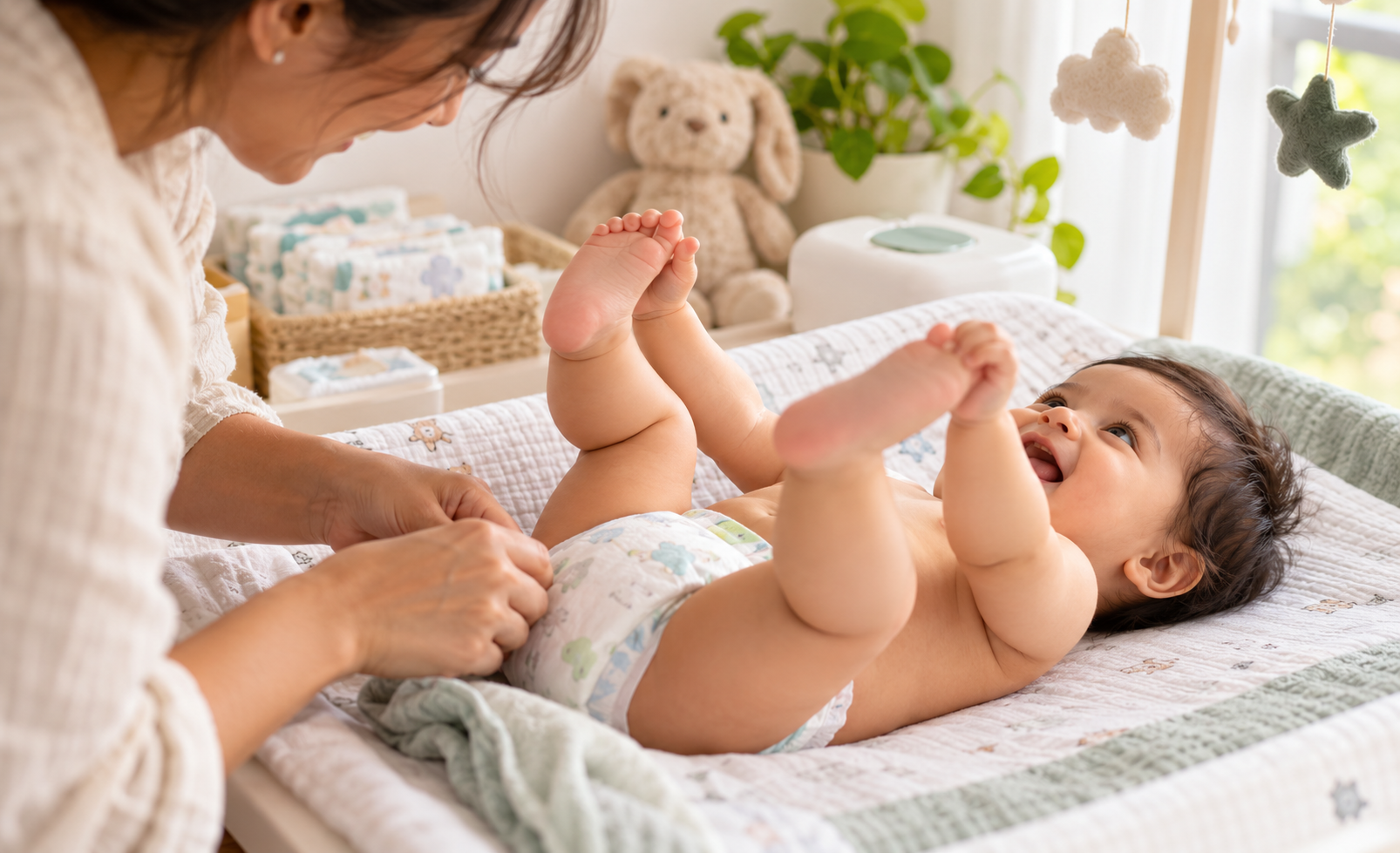
One leg goes up. The other goes sideways. Your baby turns their head, grabs their toes and somehow manages to look completely delighted by the situation.
If you have ever wondered whether your baby is deliberately making diaper changes difficult, you’re definitely not alone.
But babies don’t experience a diaper change the way adults do. For them, it can be a few minutes filled with new sensations, interesting sights, freedom of movement and opportunities to practise everything their growing body has recently learned.
And that is where the kicking, squirming and wiggling come in.
In This Article
- The Great Diaper-Change Escape Attempt
- Why the Ceiling Suddenly Becomes Fascinating
- What Happens When the Diaper Comes Off?
- When Your Baby Turns Into a Little Bicycle
- The “I Can Reach My Toes!” Phase
- Why Some Babies Wiggle More Than Others
- When Their Diaper Needs to Keep Up
- Making Room for the Wiggles
1. The Great Diaper-Change Escape Attempt
At first, your baby may happily lie where you put them.
Then one day, something changes.
They twist their shoulders.
You put them back.
They twist again.
You reach for the clean diaper and suddenly your baby is attempting what looks suspiciously like an escape from the changing mat.
This often happens as babies become more aware of what their bodies can do. Rolling, turning and pushing with their feet are no longer random movements. They are beginning to understand that movement can actually take them somewhere.
The interesting part is that they don’t necessarily want to escape from the diaper change.
They may simply have realised that there is a whole world outside the position you’ve placed them in.
And naturally, that world looks very exciting when someone has just told you to lie still.
2. Why the Ceiling Suddenly Becomes Fascinating
Have you noticed how your baby can ignore the same room all day and then become completely fascinated by it during a diaper change?
- The ceiling fan.
- A shadow.
- The curtain.
- Your face.
- The light.
Suddenly everything deserves attention.
A diaper change gives babies a different view of their surroundings. They are lying on their back, looking up, with fewer distractions from being carried or moving around.
As they become more alert, they start noticing small things that adults barely register.
This is why a baby can be perfectly happy one moment and suddenly start reaching, turning and wiggling during a change. Their attention has simply moved somewhere else.
Instead of thinking, “Why won’t you stay still?”, it can help to think, “What has caught your attention now?”
Sometimes the answer is genuinely entertaining.
Your baby may have just discovered that the ceiling fan exists.
3. What Happens When the Diaper Comes Off?
There is often a noticeable moment between removing the old diaper and putting on the fresh one.
That’s when the legs begin.
- Kick.
- Stretch.
- Kick again.
For babies, removing a diaper changes how their lower body feels. Their legs are suddenly uncovered, and they can move them more freely.
For a tiny newborn using diapers for newborn baby, those movements may look completely unpredictable. As babies grow, however, the same kicking can become much more deliberate.
They stretch because they can.
They bend their knees because they can.
They lift their feet because they have recently discovered that their feet are attached to them.
And if you have ever tried to put a fresh diaper underneath two enthusiastically moving legs, you already know how quickly this little experiment can turn into a full workout.
The good news?
You don’t have to interpret every kick as a sign that something is wrong.
Sometimes a kick is simply a kick.
4. When Your Baby Turns Into a Little Bicycle
Some babies don’t just kick.
They pedal.
Their legs move one after another in the air as though they are riding an invisible bicycle, while you are standing there trying to complete a task that was supposed to take approximately thirty seconds.
This can be especially noticeable when your baby is excited or alert.
Their whole body seems to join in. The legs move, the arms wave, the head turns and suddenly the quiet diaper change has become a one-baby fitness class.
Rather than trying to stop every movement, give yourself a little more time to work with it.
Move with the rhythm when you can instead of constantly trying to force the legs into one position.
A baby who is moving does not necessarily need to be completely still for you to finish the job.
Sometimes you just need to work around the movement.
5. The “I Can Reach My Toes!” Phase
Then comes one of the cutest—and least convenient—discoveries of babyhood.
The toes.
Once babies realise they can grab their feet, those feet can become more interesting than practically anything else.
During a diaper change, your baby may suddenly pull both knees towards their chest and start investigating their toes while you are trying to get the fresh diaper underneath them.
- You move one foot.
- They grab the other.
- You move that one.
- They find the first one again.
It can feel like you are negotiating with someone who has absolutely no interest in your schedule.
But there is something useful about this stage: your baby’s attention is telling you what interests them.
Sometimes allowing a few seconds for that exploration is easier than turning it into a battle. Let them look at their toes, talk to them about what they’re doing, and then continue once their curiosity has settled.
Not every distraction needs to be defeated.
Some can simply be allowed to happen.
6. Why Some Babies Wiggle More Than Others
Walk into a room with three babies and you might see three completely different reactions to the same diaper change.
One lies there like a tiny philosopher, staring peacefully at the ceiling.
Another kicks enthusiastically.
The third decides that this is the perfect moment to practise rolling.
Babies have different temperaments, energy levels and ways of responding to new sensations. Their mood also matters.
A baby who is excited may be much more active than a sleepy baby. A hungry baby may have very little patience. A baby who has just finished playing may not appreciate being interrupted.
This is why it can be misleading to look for one universal reason behind every wiggle.
Sometimes the explanation is simply:
“Today, my baby is feeling particularly energetic.”
Tomorrow may be completely different.
That unpredictability is part of living with a growing baby.
7. When Their Diaper Needs to Keep Up
As your baby becomes more active, the diaper has a different job to do.
It is no longer just about keeping them dry while they lie in one position. Your baby is bending, twisting, rolling, kicking and eventually moving around much more.
That means comfort and fit become increasingly noticeable.
If the diaper feels restrictive, sits awkwardly or no longer suits your baby’s changing body, you may notice more fussing during changes or more movement once it is fastened.
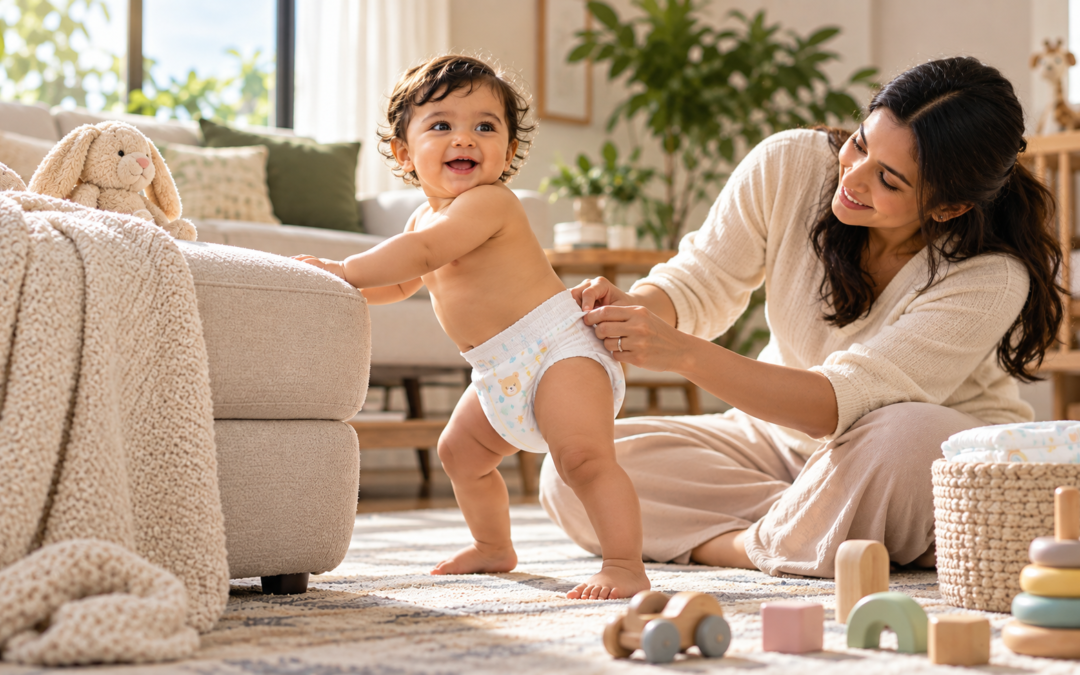
For active little ones, some parents find pant style diapers convenient because the pull-on design can make changes feel less complicated when lying still is no longer your baby’s favourite activity.
As babies become more mobile, pants style diapers for babies can also fit naturally into routines where changing often happens with a child who is standing, turning or trying to walk away.
The goal isn’t to find a diaper that magically stops your baby from moving.
It is to make sure the diaper isn’t making normal movement unnecessarily uncomfortable.
8. Making Room for the Wiggles
Perhaps the biggest change happens when you stop expecting diaper changes to look perfectly neat and predictable.
Your baby will move.
They will grab things.
They will turn their head at exactly the wrong moment.
They may decide that their toes need immediate attention.
And occasionally, they may produce a surprise that makes you very grateful you prepared for the change before removing the old diaper.
If you’re also dealing with leaks, leak proof diapers can help manage moisture, but no diaper can replace a comfortable fit and a sensible changing routine.
Keep the things you need close by, make the process familiar and let your baby move when it is safe to do so.
Most importantly, remember that movement itself isn’t necessarily a problem.
It is part of the stage your baby is going through.
Takeaway
The next time your baby kicks their legs during a diaper change, look at what is happening rather than immediately trying to stop it.
Maybe they have spotted something interesting.
Maybe they are enjoying the freedom of having their legs uncovered.
Maybe they are practising a new movement.
Maybe they have simply decided that lying still is not part of today’s plan.
Diaper changes may start as something you do for your baby, but as they grow, they become little moments where you get to watch them discover themselves.
The kicking, twisting and wiggling can be inconvenient, especially when you are already running late.
But one day, you may look back and realise that those tiny feet weren’t trying to make your life difficult.
They were busy learning what they could do.
And apparently, they had a lot to learn.