There is a particular kind of mystery that only parents of babies understand.
You change the diaper. Everything looks fine. Your baby looks perfectly comfortable. Then, after a while, you pick them up and start wondering how such a small person managed to produce such a surprisingly large amount of wetness.
The diaper still looks deceptively ordinary.
It isn’t a bucket. It isn’t a towel. It certainly doesn’t look large enough to deal with everything a baby can throw at it during a busy day.
Yet somehow, it does.
That raises a much better question than simply asking how much a diaper can absorb: where does everything actually go once it gets inside?
The answer involves a little bit of clever design, some surprisingly useful materials and one important idea that is easy to miss: keeping your baby dry isn’t just about taking liquid in. It is about what happens to that liquid after it enters the diaper.
In This Article
- Why a Diaper Isn’t Just a Tiny Towel
- The Clever Trick Happening Under the Surface
- Why One Wet Spot Doesn’t Stay One Wet Spot
- What Happens When Your Baby Keeps Adding More?
- The Part of the Diaper You Almost Never Think About
- Why Your Baby’s Sleeping Position Can Matter
- When Your Baby Starts Moving, the Rules Change
- So, What Actually Makes a Diaper Stay Dry?
1. Why a Diaper Isn’t Just a Tiny Towel
If you poured liquid onto an ordinary towel, the towel would absorb it where it landed. Keep adding more, and that area would become increasingly wet until there wasn’t much room left for anything else.
A diaper has a more complicated job.
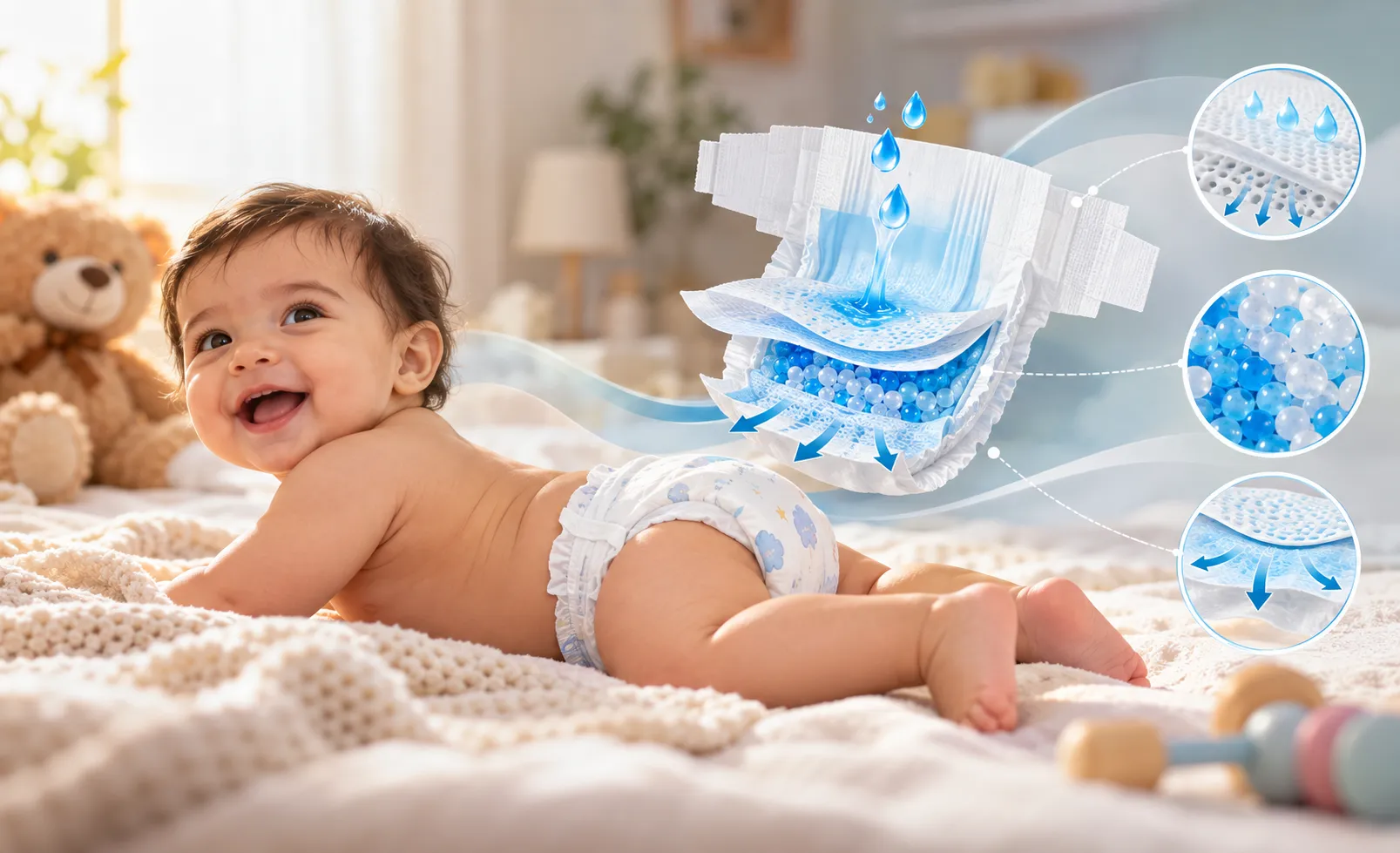
It needs to receive liquid quickly, move it away from the point where it first arrives, store it inside the absorbent area and keep it from coming back towards the baby’s skin.
That is why the inside of a modern diaper is made from several materials rather than one giant absorbent sheet. Each part has a particular role, and the way those parts work together is what gives the diaper its ability to handle repeated wetting.
So when your baby is happily sitting there looking completely innocent, there is actually a small piece of material engineering working underneath them.
Your baby doesn’t know any of this.
They’re just getting on with their day.
2. The Clever Trick Happening Under the Surface
One of the most useful materials inside many disposable diapers is called a superabsorbent polymer, often shortened to SAP.
The name sounds rather technical, but the basic idea is surprisingly simple: these tiny particles can absorb liquid and swell, helping hold that liquid inside the diaper instead of allowing it to remain free.
This is one reason modern disposable diapers can be relatively thin while still handling substantial amounts of fluid.
But absorption alone wouldn’t be enough.
Imagine pouring a glass of water onto one tiny part of a sponge and then expecting that same spot to handle several more glasses. Eventually, it would struggle.
A diaper therefore needs to move liquid through its absorbent structure so that more of the available material can do its job.
That is where the less glamorous but equally important parts of the diaper come in.
3. Why One Wet Spot Doesn’t Stay One Wet Spot
Your baby doesn’t politely distribute every wetting across the centre of the diaper.
Liquid arrives wherever your baby’s body happens to be positioned, which means the diaper has to spread it rather than simply letting one small area do all the work.
Some diapers use specially designed layers to help move liquid away from the initial wetting point and towards the absorbent core.
This matters because a diaper can have excellent absorbent material and still perform poorly if the liquid stays concentrated in one place.
It is a little like watering a plant.
You don’t want all the water sitting in one tiny patch of soil while the rest remains completely dry. You want it to spread through the available area.
A diaper is doing something surprisingly similar, only with considerably less sunshine and a much more unpredictable occupant.
4. What Happens When Your Baby Keeps Adding More?
Babies don’t usually produce one neat, convenient wetting and then wait patiently for a fresh diaper.
There may be several wettings before the next change, particularly during sleep.
This means the absorbent system has to keep working after the first wetting rather than simply becoming saturated in one place.
A useful part of this process is the diaper’s ability to retain liquid even when pressure is applied. That matters because your baby isn’t spending the entire day lying peacefully on their back. They roll, sit, get carried, sleep on their side and eventually crawl around the house.
Every movement puts a different kind of pressure on the diaper.
The challenge isn’t simply “Can it absorb liquid?”
It is “Can it continue holding that liquid while an actual baby moves around?”
That distinction explains why total absorbency alone doesn’t tell you everything about how a diaper will perform in everyday life.
5. The Part of the Diaper You Almost Never Think About
The outside of a diaper doesn’t get nearly as much attention as the soft material you see when you open one.
But it has an important job.
The outer layer helps stop liquid from travelling through the back of the diaper and onto clothing, bedding or whatever unfortunate surface your baby happens to be lying on.
Then there are the edges.
The leg cuffs and waist area help create a barrier around the places where liquid might otherwise find an easy route out.
This is particularly important because babies are not shaped like perfectly symmetrical little cylinders. Their legs bend, their stomachs move and their bodies constantly change position.
The diaper therefore has to create enough of a seal to contain moisture without making the baby feel as though they have been wrapped in packaging.
That balance is harder to achieve than it looks.
6. Why Your Baby’s Sleeping Position Can Matter
You may have noticed that leaks don’t always happen in the same place.
There is a reason.
A baby who spends most of the night in one position puts different demands on a diaper than a baby who rolls around regularly. Liquid also behaves differently depending on where it enters the absorbent area and how the baby’s body is positioned.
This is why a diaper that seems completely fine during the day may occasionally struggle overnight.
It isn’t necessarily because the diaper suddenly stopped working.
The conditions changed.
More time passed between changes. More liquid accumulated. Your baby remained in one position for longer or moved in a way that shifted where pressure was being applied.
For parents of newborns, this can be particularly noticeable because their days and nights are already made up of constantly changing patterns.
The diaper is working around your baby’s routine, not the other way around.
7. When Your Baby Starts Moving, the Rules Change
There is a funny point during the first year when you realise that your baby’s biggest challenge to the diaper isn’t actually how much they pee.
It’s where they go while wearing it.
A newborn may spend most of the day lying down. An older baby can spend the same amount of time sitting, twisting, crawling, standing and attempting to climb something they absolutely should not be climbing.
The diaper has to move with all of that.
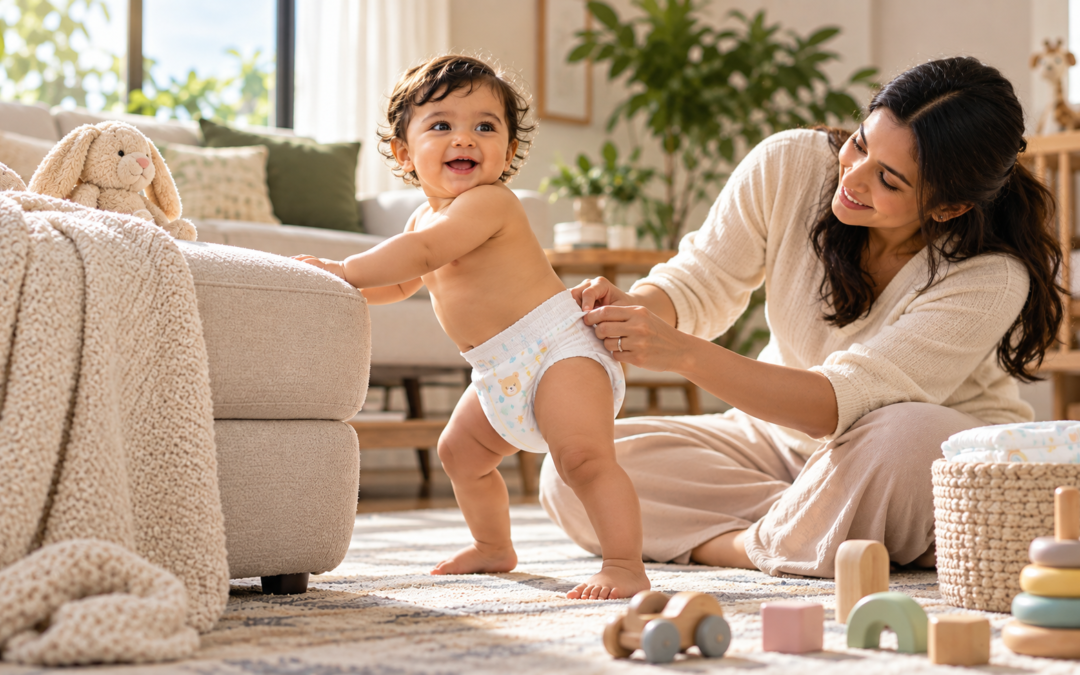
For some families, pant style diapers become useful at this stage because the pull-on design can make changes easier when a baby has become far more interested in standing than lying down.
Likewise, pants style diapers for babies can suit routines where movement has become part of practically every diaper change.
This is also why the idea of “dryness” cannot be separated from fit. A diaper can contain plenty of liquid in its absorbent core, but if it doesn’t sit comfortably around an active baby’s body, leakage can still happen.
The baby has changed the equation.
The diaper has to keep up.
8. So, What Actually Makes a Diaper Stay Dry?
It isn’t one miracle ingredient.
It isn’t simply having the largest absorbent core.
And it isn’t enough for a diaper to hold a lot of liquid under laboratory conditions.
The experience your baby has depends on several things working together: how quickly liquid is taken away from the skin, how efficiently it is distributed, how effectively the absorbent material holds it, how well the outer barriers contain it and whether the whole diaper fits your baby’s body properly.
That is why leak proof diapers are really about the entire construction rather than one individual feature.
The absorbent material matters.
The distribution matters.
The barriers matter.
And the fit matters.
When all of those pieces work together, something quite remarkable happens: your baby can spend hours sleeping, feeding, kicking, crawling or being carried around while the moisture remains contained inside a diaper that still looks surprisingly small from the outside.
Takeaway
The next time you throw a used diaper away, it is worth remembering how much has happened inside it.
Liquid has entered through the top, travelled through different layers, been distributed across the absorbent area and locked into materials designed to hold it there. Meanwhile, the outer layer and barriers have been working to keep everything contained.
And your baby has probably contributed absolutely nothing to the process except eating, sleeping, kicking and getting on with being a baby.
That is what makes diaper technology so interesting.
The diaper doesn’t ask your baby to stay still, follow instructions or make its job easier. It has to work around the wonderfully unpredictable little person wearing it.