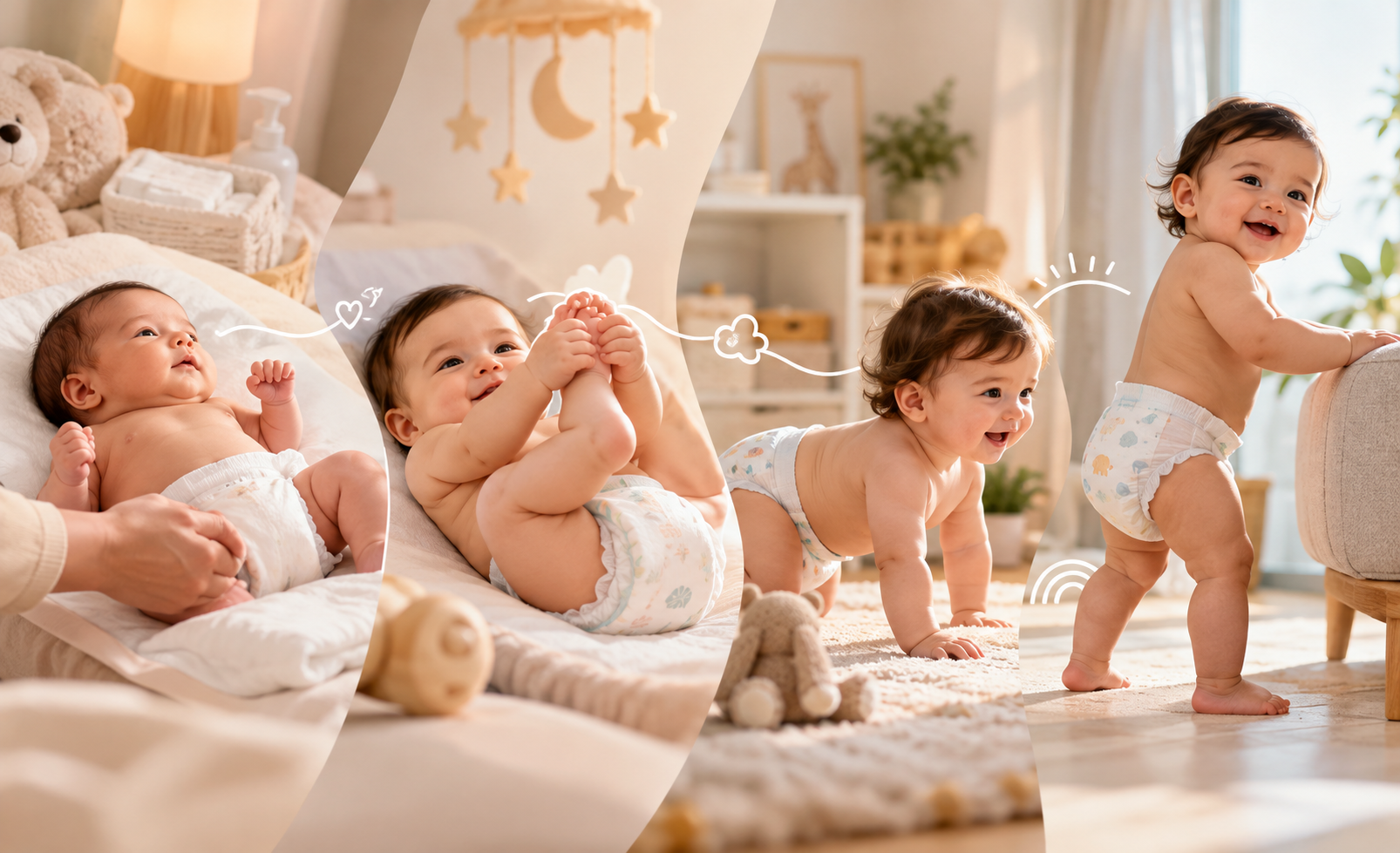
When you bring a newborn home, a diaper change can feel like a carefully planned operation.
The diaper is opened. The wipes are ready. The baby is placed gently on the changing mat. You take a breath, hoping everything goes smoothly.
A few months later, that same routine can look completely different.
Your baby may be fascinated by their toes, determined to roll towards the edge of the mat or suddenly interested in whatever is happening across the room. Later, they may crawl away the moment you say it is time for a change, and eventually you may find yourself trying to put on a fresh diaper while your little one is much more interested in standing.
That is the funny thing about the first year. You don’t simply get better at changing diapers; your baby keeps changing the rules.
What starts as a quiet newborn routine gradually becomes part of a much bigger journey of curiosity, movement and independence.
In This Article
- The Newborn Days: When Everything Is Still New
- When Your Baby Discovers Their Own Little World
- The Changing Mat Becomes a Place to Explore
- When Your Baby Starts Making Diaper Changes Personal
- The Crawling Stage: Suddenly, There Is Somewhere to Go
- When Standing Changes the Routine Again
- Your Baby Grows, and the Diaper Has to Keep Up
- Looking Back at the First Year
1. The Newborn Days: When Everything Is Still New
In the first few weeks, you are probably thinking about diaper changes far more than your baby is.
You are checking whether the fit looks right, wondering if you have fastened everything properly and learning how to handle those impossibly small legs without feeling as though you are handling something made of glass. Even getting the clothes back on can seem like a small achievement when you are still getting used to your new routine.
This is where diapers for newborn baby become part of everyday life. You start noticing how different sizes fit, how often your baby needs a change and which little signs tell you that it is time to get everything ready.
The routine may feel repetitive, but there is something comforting about that repetition. Your baby is learning your voice and your touch, while you are slowly learning their expressions, sounds and habits.
At this point, diapering is mostly about care.
Your baby hasn’t discovered yet that they can turn it into an event.
2. When Your Baby Discovers Their Own Little World
Then your baby’s attention begins to stretch beyond your face.
The ceiling fan becomes fascinating. A shadow on the wall deserves serious investigation. The sound of someone walking down the hallway can make your baby turn their head immediately, even though you are halfway through getting them dressed.
This is when diaper changes can become unexpectedly entertaining.
You might be talking to your baby while they stare past you at something you cannot understand the fascination with. Instead of simply waiting for the change to finish, they are beginning to observe what is happening around them and respond to it.
These little moments are easy to overlook because they happen during an ordinary task, but they tell you something important: your baby’s world is getting bigger.
The changing mat isn’t just where you put a clean diaper anymore. For a few minutes, it becomes a comfortable place from which your baby can watch the world go by.
3. The Changing Mat Becomes a Place to Explore
There is usually a point when you realise your baby has become much more interested in their own body.
Their hands find their feet. Their knees come up towards their tummy. They stretch, twist and experiment with movements that were barely noticeable a few weeks earlier.
A diaper change can suddenly become an opportunity for your baby to practise whatever new movement they have discovered.
You might be trying to position a fresh diaper while your baby is busy examining their toes. Instead of seeing this as a delay, it can be helpful to remember that your baby has no idea you have a schedule to follow. They have just discovered something fascinating, and right now, their feet are apparently the most interesting things in the room.
This is also one of those stages when you begin to see how quickly babies develop. Something that was impossible last month can suddenly become part of their everyday behaviour.
The diaper change hasn’t become more complicated because you are doing anything differently.
Your baby has simply become more curious.
4. When Your Baby Starts Making Diaper Changes Personal
As babies become more aware of their surroundings, they also start developing very clear preferences.
Some babies love being talked to during a change. Others want to hold whatever is nearby. Some seem perfectly happy until you try to put their clothes back on, at which point they suddenly remember that they had much more important plans.
These little preferences are part of what makes the first year so unpredictable.
You begin learning what makes your baby comfortable rather than relying on a single routine that works every time. Maybe singing keeps them interested. Perhaps talking through what you are doing makes the process calmer. You may even notice that certain times of the day are easier than others.
The more you observe, the more familiar these patterns become.
And this is when diapering starts feeling less like a repetitive task and more like one of the many small ways you are learning your baby’s personality.
5. The Crawling Stage: Suddenly, There Is Somewhere to Go
Crawling changes the conversation completely.
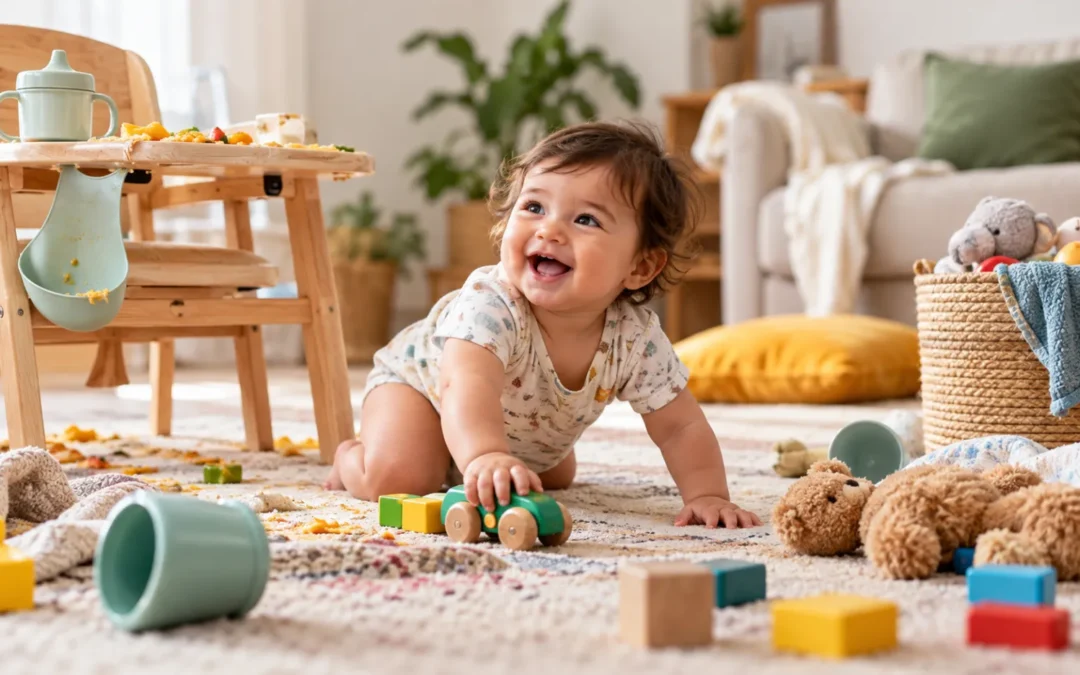
Your baby now has somewhere to go, and unfortunately, diaper time often arrives precisely when they are most interested in getting there.
Imagine your little one has spent several minutes working their way towards a toy across the room. They are finally close enough to reach it when you decide that a diaper change cannot wait.
From your perspective, it is a routine task.
From theirs, you have interrupted an expedition.
This is when parents often become remarkably good at preparing everything before the change begins. A clean diaper, wipes and clothes need to be close because there is little value in reaching across the room once your baby has decided to investigate something else.
The interesting part is that your baby’s new mobility isn’t really making them “difficult.” They are simply discovering that they can choose where to go, and that newfound freedom is understandably exciting.
Diapering has to fit around that growing independence rather than pretending it isn’t happening.
6. When Standing Changes the Routine Again
Once your baby discovers how to pull themselves upright, the changing mat may suddenly become much less popular.
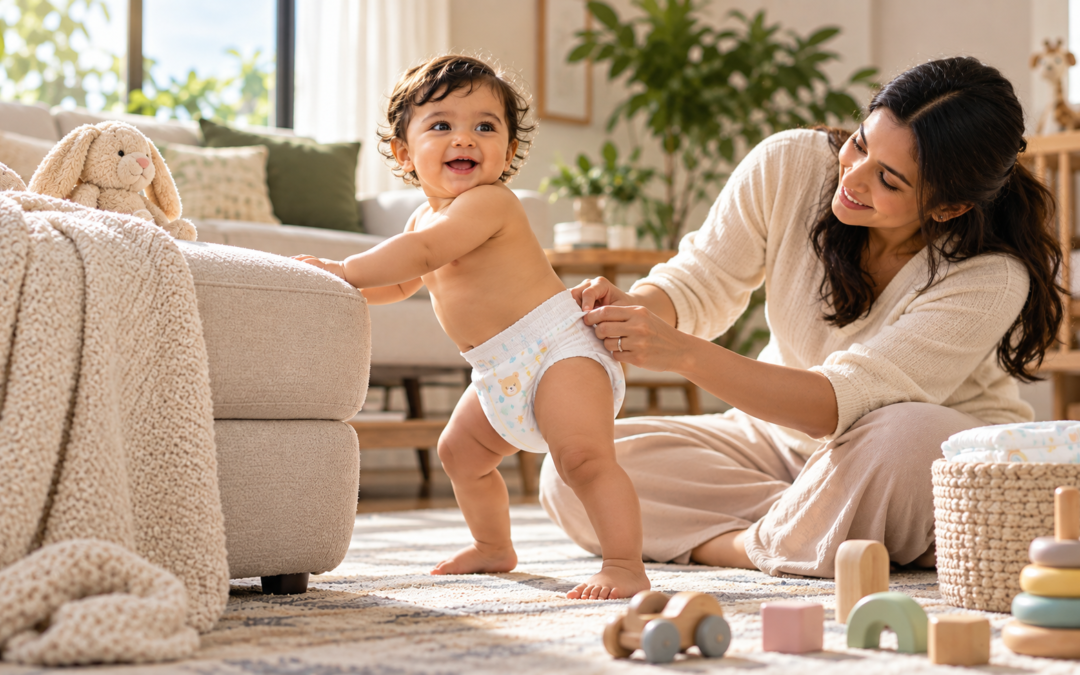
Standing gives them a completely different view of the room, and they are often eager to practise their new skill whenever they can. A baby who once needed you to move every part of their body may now be holding onto the sofa and waiting impatiently for you to finish.
This is where pant style diapers can become a practical option for some families. When your little one is much happier standing than lying down, a pull-on design can make certain changes easier to manage without turning the whole process into a negotiation.
The change is subtle but significant. You are no longer simply caring for a baby who stays where you put them. You are helping a little person who is becoming increasingly involved in what happens to them.
Soon, they may even try to help with getting dressed.
Whether that actually makes the process faster is another question.
7. Your Baby Grows, and the Diaper Has to Keep Up
During the first year, your baby’s body changes rapidly, but their lifestyle changes just as much.
A newborn may spend most of the day sleeping and feeding, while an older baby can spend hours sitting, crawling, pulling themselves up and exploring every reachable corner of the house.
Naturally, diapering needs to adapt.
You may start paying closer attention to whether the diaper stays comfortably in place while your baby moves or whether the style you have been using still suits your everyday routine. Pants style diapers for babies can be useful for families whose little ones have become particularly active and increasingly resistant to lying down for changes.
Leaks can also become more frustrating once your baby spends less time in one position. Leak proof diapers may help with moisture management, but a suitable size and comfortable fit are still important because a baby’s body can change surprisingly quickly during this stage.
There is no magic month when every baby needs to switch to a particular style.
The better question is much simpler: Does the diaper still work comfortably for the baby you have today?
8. Looking Back at the First Year
The strange thing about diapering is that you probably won’t remember most of the individual changes.
There are simply too many.
What you remember are the moments around them.
You remember how tiny your baby looked during those first weeks. You remember the fascination with their toes, the first attempts to turn over and the moment you realised that putting them down no longer meant they would stay there.
You remember the crawler who suddenly had somewhere else to be and the little explorer who became determined to stand every chance they got.
Eventually, you realise that diapering has been quietly keeping pace with every major change.
At first, you were learning how to care for your baby.
Then you were learning how to keep up with them.
By the end of the first year, you may be looking at a little person who is pulling themselves up, taking tentative steps and already showing a surprising amount of independence.
And somehow, every stage happened between ordinary diaper changes.
Takeaway
The first year doesn’t simply make your baby bigger. It changes the way they experience the world.
A newborn depends on you for almost everything, while a few months later, that same child is reaching for their toes, watching everything around them and testing what their body can do. Before long, they are crawling towards whatever has caught their attention, standing against the furniture and beginning to imagine what it might feel like to walk.
Your diapering routine naturally follows that journey.
What once required patience and careful concentration eventually requires preparation, flexibility and a good sense of humour.
So if diaper changes seem to keep getting different, you’re not doing anything wrong.
Your baby is simply growing faster than your routine can keep up.
And perhaps that is the best thing about first-year diapering: when you look back, you won’t just remember the diapers.
You’ll remember the tiny person who was changing right in front of you.