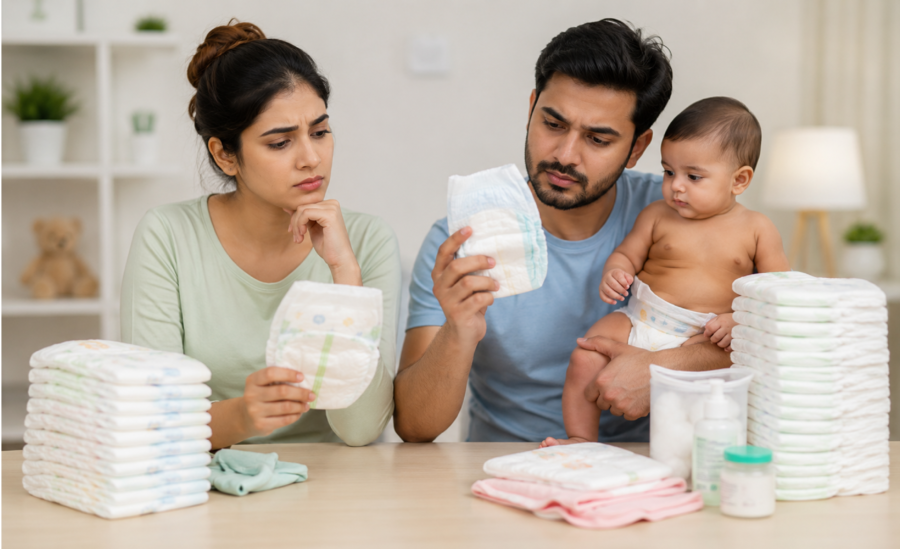
When parents see terms such as “eco-friendly,” “natural,” “biodegradable,” or “sustainable” on a baby diaper pack, it is easy to assume that the product is automatically better for the baby and the planet.
But choosing a diaper is more complicated than looking for a green label.
A diaper needs to manage moisture, contain leaks, fit comfortably, protect delicate skin, and remain practical for everyday use. At the same time, parents may want to reduce plastic use, packaging waste, or the environmental impact associated with disposable diapers.
So, are eco-friendly baby diapers really better?
Sometimes—but not simply because they are marketed as eco-friendly.
The better approach is to look at the materials, manufacturing claims, absorbency, fit, packaging, certifications, disposal method, and your baby’s individual needs.
What Does “Eco-Friendly” Actually Mean on a Diaper?
“Eco-friendly” is not a single material or performance standard.
A diaper described as “eco-friendly” may focus on one or several aspects of its environmental profile, such as
- Reduced use of certain materials
- Plant-derived or renewable materials
- Recycled packaging
- Reduced packaging
- Manufacturing practices intended to lower environmental impact
- Partial biodegradability
- Specific sustainability certifications
These features can be meaningful, but one environmental benefit does not necessarily make the entire diaper environmentally preferable in every respect.
For example, a diaper may contain a plant-based component while still containing plastics and super-absorbent materials. Similarly, “biodegradable” does not necessarily mean that the diaper will break down quickly under normal landfill conditions.
That is why parents should look beyond broad environmental claims and examine what the product actually contains.
Are Eco-Friendly Diapers Better for Babies?
Not automatically.
Environmental claims and baby-skin claims are two different things.
A diaper that is marketed as sustainable still needs to be comfortable, appropriately fitted, and effective at managing moisture.
The American Academy of Pediatrics notes that diaper rash can be associated with prolonged contact with urine or stool, friction, and other factors. It also notes that some babies can react to specific ingredients such as dyes, fragrances, or materials in diapers and related products.
For parents, this means the most important questions are not simply
“Is this diaper eco-friendly?”
but also
“Does it keep my baby’s skin reasonably dry?”
“Does it fit properly?”
“Does it cause rubbing or irritation?”
“Does it perform well enough for my baby’s needs?”
An environmentally conscious diaper is only a practical choice if it also works well for your baby.
What Materials Are Used in Disposable Baby Diapers?
Understanding diaper construction can make environmental claims easier to evaluate.
A modern disposable diaper commonly contains several functional layers, which may include:
- A topsheet that touches the baby’s skin
- An absorbent core
- Super-absorbent material
- Tissue or other absorbent components
- Elastic materials
- Fastening or waistband components
- An outer barrier layer
- Adhesives and other construction materials
The U.S. Environmental Protection Agency identifies disposable diapers as a waste category that can include wood pulp, plastics, super-absorbent materials, and tissue paper. It also reported that significant recycling or composting of disposable diapers was not identified in its 2018 data.
This highlights an important point: disposable diapers are not usually made from one material.
Therefore, replacing one component with a plant-derived or recycled material does not necessarily make the complete product biodegradable or compostable.
Does “biodegradable” mean the whole diaper will break down?
Not necessarily.
One of the most common misunderstandings is treating “biodegradable,” “compostable,” and “eco-friendly” as interchangeable terms.
They are not.
A product can contain a biodegradable component without the entire diaper being biodegradable. Similarly, a material may be compostable only under specific conditions that are not available through normal household waste collection.
Parents should, therefore, look for precise information about:
- Which component is biodegradable
- Under what conditions it breaks down
- Whether the complete diaper is biodegradable
- Whether it is commercially compostable or home compostable
- What disposal facilities actually accept it
A claim without these details provides limited information about the product’s real end-of-life impact.
Can Disposable Diapers Be Recycled?
This is another area where expectations can differ from reality.
Used diapers contain bodily waste and are made from multiple materials, which makes recycling complicated.
The EPA currently advises consumers to check with their local waste or recycling authority and generally recommends disposing of used diapers in the trash after removing and flushing fecal matter where appropriate.
This means parents should not assume that a diaper can go into the regular household recycling bin simply because some part of it is recyclable.
If a manufacturer claims that a diaper or specific component can be recycled, check whether there is an actual collection system available in your area.
Does “Natural” Mean Better for Sensitive Baby Skin?
Not necessarily.
“Natural” describes the origin or marketing position of an ingredient; it does not automatically mean that the material will be more suitable for every baby’s skin.
Babies can have different sensitivities, and even products perceived as gentle can cause problems for an individual child.
The American Academy of Pediatrics recommends fragrance-free diaper wipes and products when caring for diaper-area skin and notes that fragrances, preservatives, dyes, or elastics can sometimes be associated with allergic reactions.
For parents with a baby who has sensitive skin, it can therefore be more useful to focus on the actual ingredients and the baby’s response rather than assuming that a “natural” label guarantees gentleness.
Fit Matters More Than Many Parents Realize
A diaper can have excellent materials and still be the wrong choice if the fit is poor.
A diaper that is too tight can rub against the skin and trap moisture. One that is too loose may allow leaks.
As babies grow, their diaper size needs can change quickly.
Parents should look for signs such as the following:
- Red marks around the waist or legs
- Frequent leaks
- Gaps around the legs
- The diaper sitting too low or high
- Difficulty fastening the diaper comfortably
- Frequent blowouts
- Visible discomfort during movement
The American Academy of Pediatrics specifically notes that diapers that are too tight can contribute to moisture retention, rubbing, and irritation and recommends considering a larger size when elastic leaves red marks.
When Should Parents Move to Large-Size Baby Diapers?
Size should be based on the baby’s fit and the manufacturer’s weight or sizing guidance rather than age alone.
Large size baby diapers may become appropriate when the current diaper starts leaving marks, feels restrictive, leaks more often, or becomes difficult to fasten comfortably.
A larger diaper is not automatically better, though. If the leg openings are too loose, leakage can increase.
The goal is a secure but comfortable fit that allows the baby to move freely.
What Are Pant-Style Diapers?
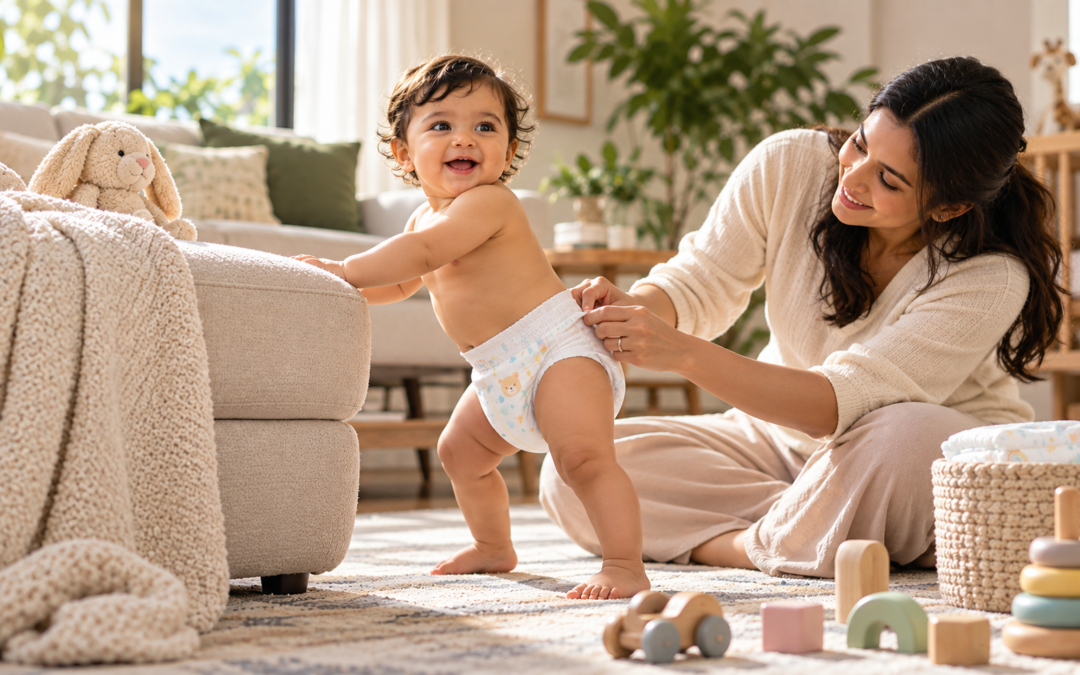
Pants style diapers for babies are designed to be pulled up and worn more like underwear than traditional taped diapers.
They can be particularly convenient as babies become more active and begin crawling, standing, walking, or resisting diaper changes.
Common features can include:
- Stretchable waistbands
- Elastic leg openings
- Pull-up construction
- Flexible movement
- Easy on-and-off handling
The main advantage is convenience and freedom of movement. However, parents should still evaluate absorbency, fit, skin comfort, leakage protection, and material claims before choosing a particular product.
Are Pants-Style Diapers Better for Active Babies?
They can be convenient for active babies because the pull-up design can make diaper changes easier when a child is moving around.
However, “better” depends on the baby’s stage and the parent’s priorities.
Some parents prefer taped diapers for younger babies because they allow easier adjustment while the baby is lying down. Others prefer pant-style products once the child becomes more mobile.
The important thing is to select a size that provides a comfortable seal without being excessively tight.
What Should Parents Look for in an Eco-Friendly Diaper?
Instead of relying on one sustainability claim, evaluate the product across several areas.
1. Look at the materials
Check which materials are used in the topsheet, absorbent core, outer layer, elastic components, and packaging.
If a product highlights a plant-derived material, determine which part of the diaper it applies to.
2. Check sustainability certifications
Independent certifications can provide more useful information than vague phrases such as “green” or “planet friendly.”
However, parents should understand what a particular certification actually evaluates before treating it as proof of overall environmental superiority.
3. Examine the packaging
Packaging is part of the product’s environmental footprint.
Look for information about recycled content, recyclability, packaging reduction, and disposal instructions.
4. Look at the manufacturer’s claims carefully
A strong environmental claim should be specific enough to understand.
For example, “contains X% plant-derived material” communicates more information than simply saying “made with natural materials.”
5. Consider diaper performance
A diaper that repeatedly leaks may lead to more frequent changes, additional cleaning, and potentially more products being used.
Environmental impact should therefore be considered alongside actual performance.
Is a More Absorbent Diaper Automatically More Sustainable?
Not necessarily.
Absorbency is important because it helps manage moisture and can support skin comfort. The AAP recommends highly absorbent diapers as part of diaper-rash prevention because keeping the skin drier can be beneficial.
But absorbency alone does not determine environmental impact.
A diaper’s overall footprint can involve its materials, manufacturing, transportation, packaging, usage, and disposal.
This is why comparing only one feature—such as absorbency, recycled content, or plant-based material—does not provide the complete picture.
How Much Does the Diaper Size Matter?
Size affects both comfort and performance.
A diaper that is too small may create pressure, rubbing, and leaks. A diaper that is too large may leave gaps around the legs and waist.
As babies grow, parents may move through several sizes.
For example, parents may eventually compare medium size baby diapers with larger options as their baby becomes heavier and more active.
Rather than changing size based only on age, observe how the current diaper fits and follow the manufacturer’s sizing recommendations.
Should Parents Choose Diapers Based on Price or Environmental Claims?
Neither price nor a sustainability label tells the entire story.
A lower-priced diaper may work perfectly well for one baby but not another. Likewise, a premium diaper with an environmental claim may not be the best choice if it does not fit properly or causes frequent leaks.
A better decision considers:
Safety + fit + absorbency + skin comfort + materials + environmental information + value.
This gives parents a more balanced way to compare products.
How to Avoid Greenwashing When Buying Baby Diapers
Greenwashing happens when environmental messaging creates a stronger impression of sustainability than the available evidence supports.
Parents can reduce the risk of being misled by asking practical questions:
Is the claim specific?
“Eco-friendly” is broad.
“Packaging contains X% recycled material” is more specific.
Does the claim apply to the entire diaper?
A single plant-based component does not necessarily mean the entire diaper is biodegradable.
Is there supporting information?
Look for certification details, material information, or clear explanations from the manufacturer.
Does the company explain disposal?
A sustainability claim should be considered alongside what happens after the diaper is used.
Are environmental claims being confused with health claims?
A diaper can have a reduced-impact material without being proven to be better for a baby’s skin.
These distinctions help parents make decisions based on evidence rather than packaging language.
What About Newborn and Small-Size Diapers?
Newborns have different practical needs from older, more active babies.
For very young babies, parents often prioritize:
- A secure fit around the legs
- Gentle contact with delicate skin
- Reliable absorbency
- Easy changes
- A suitable waistband
- Appropriate sizing
Parents searching for baby diapers small size should focus on the manufacturer’s recommended weight range and the baby’s actual fit rather than choosing solely based on the word “newborn.”
As the baby grows, sizing should be reassessed regularly.
Are Eco-Friendly Diapers Worth the Extra Cost?
That depends on what you value and what the product actually offers.
If a diaper provides meaningful material or packaging improvements, performs well, fits your baby comfortably, and fits your budget, the additional cost may be worthwhile for your household.
But a higher price alone does not prove that a diaper has a lower environmental impact.
Parents should compare specific claims rather than assuming that the most expensive option is automatically the most sustainable.
A Practical Checklist for Choosing Baby Diapers
Before buying, consider these questions:
- Does the diaper fit my baby’s current size?
- Does it prevent leaks during normal use?
- Does it keep moisture away from the skin effectively?
- Does my baby experience irritation when using it?
- Are fragrance and other optional additives clearly disclosed?
- What materials are used?
- Are sustainability claims specific?
- Is there independent certification where relevant?
- What happens to the diaper after disposal?
- Is the price reasonable for regular use?
This approach is more reliable than choosing a product based on one attractive phrase on the package.
Are Eco-Friendly Diapers Really Better?
There is no universal yes-or-no answer.
An eco-friendly diaper may have advantages in a particular area, such as using more renewable materials, reducing packaging, or providing verified environmental improvements.
But “eco-friendly” does not automatically mean the following:
- Completely biodegradable
- Compostable at home
- Plastic-free
- Better for every baby’s skin
- More absorbent
- More comfortable
- Better value
Parents should evaluate the complete product rather than a single marketing claim.
The most responsible choice is one that balances the baby’s needs with realistic environmental considerations.
Frequently Asked Questions
Are eco-friendly baby diapers actually better for the environment?
They can be, depending on their materials, manufacturing processes, packaging, and disposal options. However, the term “eco-friendly” alone does not establish the overall environmental impact of a diaper.
Are biodegradable diapers completely biodegradable?
Not necessarily. Some diapers contain biodegradable components while also containing plastics, adhesives, elastic materials, or super-absorbent components. Parents should check exactly what the manufacturer’s biodegradability claim covers.
Can disposable diapers be recycled?
Used disposable diapers generally cannot simply be placed in standard household recycling. Waste systems vary, so parents should follow local disposal guidance and any specific collection program offered in their area.
Are eco-friendly diapers safer for babies?
Environmental credentials do not automatically determine skin safety. A baby’s comfort depends on factors including fit, moisture management, friction, and individual sensitivity to particular materials or ingredients.
Are natural materials better for sensitive baby skin?
Not necessarily. “Natural” does not automatically mean hypoallergenic or suitable for every baby. Parents should check the ingredient and material information and monitor how their baby’s skin responds.
What should I look for in pant style diapers?
Look for an appropriate size, comfortable stretch, secure leg openings, reliable absorbency, leak protection, and materials that suit your baby’s skin.
When should I switch to large size baby diapers?
Consider moving up when the current diaper leaves persistent marks, becomes difficult to fasten, causes frequent leaks, or appears restrictive. Always check the manufacturer’s recommended weight range as well.
Are pant-style diapers suitable for newborns?
It depends on the product. Traditional taped diapers are often convenient for very young babies, while pull-up designs may become particularly useful as babies become more active. Always follow the manufacturer’s age and size guidance.
Are more expensive eco-friendly diapers better?
Not necessarily. Price does not prove environmental performance or better baby care. Compare materials, certifications, performance, fit, and specific sustainability claims before deciding.
What is greenwashing in baby diapers?
Greenwashing occurs when environmental marketing creates an exaggerated impression of sustainability. Parents can avoid it by looking for specific, measurable claims and understanding exactly which part of the diaper the claim applies to.
Do eco-friendly diapers reduce diaper rash?
There is no general guarantee that an eco-friendly diaper will prevent diaper rash. Diaper rash can have multiple causes, including moisture, stool contact, friction, and individual sensitivity.
Final Takeaway
Choosing a baby diaper is not simply a choice between “eco-friendly” and “traditional.”
A genuinely good diaper needs to work for both the baby and the household. It should provide an appropriate fit, absorb moisture effectively, minimize unnecessary irritation, and perform reliably during everyday use.
Environmental considerations matter too, but parents should look beyond broad labels. Check the materials, certifications, packaging, disposal instructions, and the exact wording of sustainability claims.
The same principle applies when choosing pant style diapers or moving to large size baby diapers: comfort, fit, absorbency, and practicality should remain part of the decision.
An eco-friendly claim can be a useful starting point—but it should never be the only reason to buy a diaper.
The best choice is an informed one: understand what the diaper is made of, what its environmental claims actually mean, how it performs for your baby, and what happens to it after use. That gives parents a more realistic way to balance baby care with environmental responsibility.