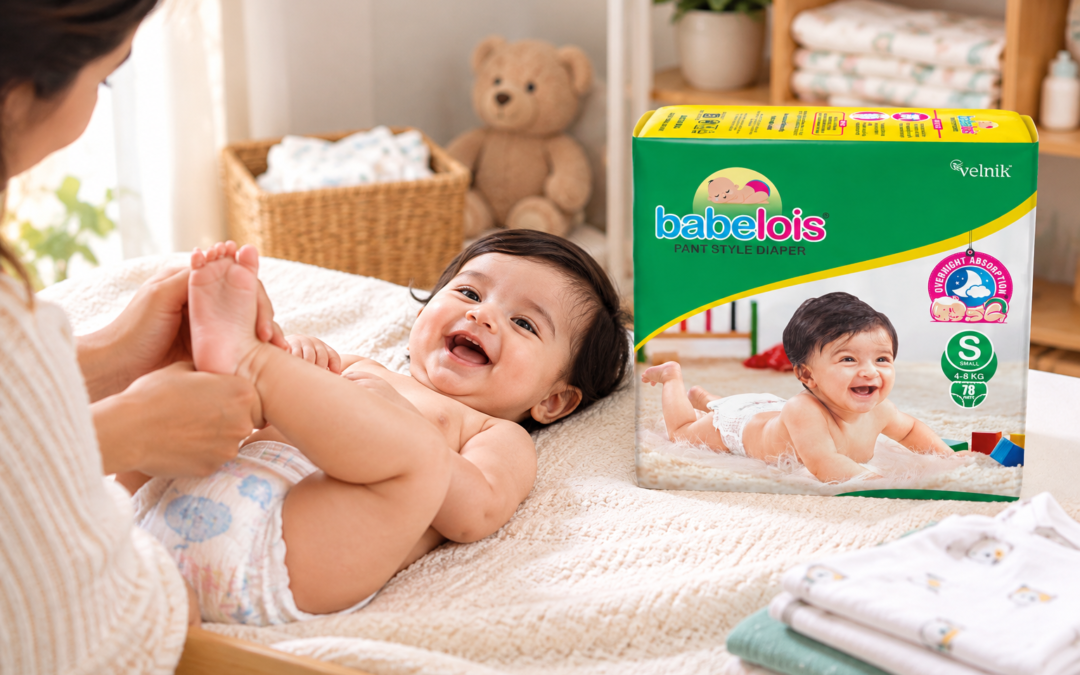
Imagine buying an adult diaper, shrinking it until it fits a newborn, and assuming the job is done. After all, a diaper absorbs liquid, contains mess and helps protect clothing. How complicated could it be?
Quite complicated, actually.
A newborn has tiny thighs, a delicate belly button and a body that changes rapidly over the first months. An adult may need protection during a workday, overnight or while managing incontinence. Both need a product that works reliably, but their bodies and everyday challenges are worlds apart.
That’s why baby and adult diapers aren’t simply different-sized versions of the same thing. Their similarities are interesting—but their differences tell an even better story.
1. A Baby’s Thighs Can Tell You More Than the Size Label
Here’s a small design challenge: how do you make a diaper stay in place on someone who spends the morning kicking, the afternoon crawling and the evening attempting to climb over cushions?
You start with the fit.
Baby diapers are shaped around small waists, rounded thighs and the proportions of a growing body. Elasticated leg openings and waistbands help the diaper sit securely without making it uncomfortably tight.
Adult diapers have a different job. They need to accommodate a much wider range of body shapes, from people who move around independently to those who need help with daily care.
The distinction isn’t simply that one is smaller. The shape has to work for the person wearing it.
A gap around a baby’s thigh can become a route for leakage. A fit that’s too tight may leave marks or cause discomfort. For adults, an unsuitable fit can also affect comfort, security and how well the product contains leakage.
The same basic principle applies to both: a carefully designed absorbent core can’t do its job properly if the product doesn’t fit as intended.
2. The Great Diaper Experiment: What Happens to the Liquid?
Let’s imagine two products on a laboratory bench: one designed for a baby, the other for an adult.
Add liquid to each, and you’ll find that they may rely on similar technology. Many disposable diapers contain an inner layer that lets liquid pass through, an absorbent core and an outer barrier that helps prevent leakage.
The core may combine cellulose fibres with superabsorbent polymers. These polymers take in liquid and swell into a gel-like material that helps retain it.
So, if the technology is similar, why not use the same product for everyone?
Because using similar materials doesn’t mean a product has the same capacity, shape or intended use.
Adult incontinence products may be designed to manage larger volumes of urine, depending on the product. Their absorbent area and core construction can differ from those of baby diapers. Baby products, meanwhile, must fit securely on a much smaller body.
And there’s no universal rule that every adult diaper holds more than every baby diaper. Capacity varies by product and size.
The useful takeaway? Don’t judge a diaper by its dimensions alone. Its construction and intended purpose matter just as much.
3. The Newborn Detail That Changes the Design
A newborn comes with a very specific design consideration: the umbilical stump.
Until it heals, the area needs care, and a diaper that rubs against it may cause unnecessary irritation. Some newborn diapers therefore feature a lowered or shaped front to help keep the edge away from the stump.
It’s a tiny adjustment, but it illustrates something important: baby products sometimes need features that have nothing to do with absorbency.
Adult diapers generally don’t need this newborn-specific design consideration. Instead, adult products may focus on other needs, such as accommodating different levels of incontinence, body shapes or changing requirements.
When selecting diapers for newborn baby, look for an appropriate weight range and a comfortable fit around the waist and legs. Follow the manufacturer’s instructions and your healthcare professional’s guidance for caring for the healing umbilical area.
A diaper isn’t just a container for liquid. It’s a product designed around the person using it—and sometimes, the smallest details are the clearest proof.
4. Pull-On Pants or Fastening Tabs: Who Is Doing the Changing?
Picture two very different scenes.
In the first, a parent is trying to change a wriggling toddler who has decided that lying still is no longer an option.
In the second, an adult receiving care needs a product that can be changed comfortably without having to stand or remove clothing completely.
The best design may be different in each situation.
Pant style diapers pull on like underwear. For babies who are crawling, standing or constantly twisting during changes, this design can make everyday dressing more convenient. That’s one reason pants style diapers for babies may appeal to parents as their little ones become more active.
Adult pull-on protective underwear can also be useful for people who can manage dressing themselves. However, adult products are also available with side fasteners, which can make changes easier for people with limited mobility or caregivers assisting them.
Notice the common thread? The fastening system isn’t merely a styling choice. It affects how the product is put on, removed and used in everyday life.
Neither pull-on nor tab-fastened designs are automatically better for everyone. The right choice depends on the wearer’s needs.
5. Why the Biggest Absorbency Claim Doesn’t Always Win
Suppose two diaper packages make impressive promises about leakage protection. Which one should you choose?
The biggest claim might catch your attention, but it doesn’t tell you everything.
A diaper can leak because its absorbent core has reached capacity, because the fit leaves gaps, or because the product has shifted. The amount of liquid, the product’s design and how it is worn all influence performance.
When shopping for leak proof diapers, remember that no product can guarantee zero leaks in every circumstance.
For babies, check that the leg gathers sit correctly and that the waistband is comfortable. For adults, choose a product intended for the person’s level of leakage and follow its fitting instructions.
And here’s an important point: more absorbent material isn’t automatically the answer to every leak. If the product doesn’t fit properly, liquid may escape before the absorbent core can contain it.
Sometimes the solution is a different size or design. Sometimes the product needs changing sooner. Finding the cause is more useful than relying on a single claim printed on the package.
6. The Skin Has Different Needs at Different Ages
A diaper can manage moisture without making skin care unnecessary.
For babies, prolonged contact with urine or stool, friction and moisture can contribute to diaper-area irritation. Their skin needs gentle care, and wet or soiled diapers should be changed promptly.
Adults who use incontinence products face their own skin-care considerations. Extended exposure to moisture and irritants can also contribute to skin problems, particularly when products aren’t changed as needed.
Both groups benefit from a product that fits correctly, manages moisture effectively and can be changed according to the wearer’s needs.
The difference lies in the details of care, the person’s skin condition, mobility and daily routine—not simply in age.
7. Could You Use a Baby Diaper for an Adult? Or an Adult Diaper for a Baby?
It’s a reasonable question if the products appear to do the same basic job. But using a product outside its intended size range or purpose isn’t a good substitute for choosing the right design.
A baby diaper may not provide an appropriate fit or the required absorbency for an adult. An adult diaper may be unsuitable for a baby’s body, particularly around the waist and legs, and may not include features designed for newborn care.
Even when a product seems to fit, appearance alone doesn’t establish that it will perform as intended.
Choose a diaper made for the wearer’s size and needs, and follow the manufacturer’s guidance. If leakage or fit problems persist, reassess the product rather than trying to make an unsuitable one work.
The Real Difference Is in the Details
Baby and adult diapers share a mission: manage waste, help contain leakage and protect clothing. Many use similar absorbent materials to do it.
But a diaper is more than an absorbent core wrapped in fabric. Its shape, fastening system, absorbency, fit and ease of changing all determine how well it works in real life.
For a baby, that might mean accommodating tiny thighs, constant movement and a healing umbilical stump. For an adult, it may mean supporting independent dressing, assisted changes or different levels of incontinence.
The size difference is obvious. The thoughtful design behind it is what really matters.