
Before having a baby, buying diapers seems like one of those things you can easily tick off the list. You choose a brand, pick a size, put a few packs in the nursery and assume you are ready.
Then your baby arrives, and you realise that diapering is going to be a much bigger part of your life than you expected.
It happens when you are wide awake, when you are barely awake, before a feed, after a feed, just before leaving the house and sometimes immediately after you have changed a perfectly clean diaper. You start noticing how quickly your baby goes through diapers, which size fits best, how to recognise a diaper that needs changing and, eventually, how to pack a diaper bag without taking half the nursery with you.
The first 100 days are really a period of getting to know your baby. Diapering becomes part of that process because those everyday changes give you countless little opportunities to notice what is normal for your baby and what has changed.
And there are quite a few things nobody thinks to mention before you bring your newborn home.
In This Article
- Why Does It Feel Like Your Baby Needs a New Diaper All the Time?
- The First Few Days Can Make You Question Everything
- You Will Eventually Know What Your Baby’s Diaper Is Telling You
- The One Thing That Makes Every Diaper Change Easier
- Why Your Baby’s Clothes Keep Getting Involved
- When Nighttime Changes Become Their Own Routine
- Your Baby May Outgrow the Diaper Before You Notice
- What Changes by the End of the First 100 Days?
1. Why Does It Feel Like Your Baby Needs a New Diaper All the Time?
One of the first surprises for new parents is how quickly the diaper supply disappears. You may start the morning with a full pack nearby and wonder where most of it went by evening.
Newborns simply need frequent changes. During the early weeks, it is common for a baby to need around 10–12 diaper changes in a day, although the exact number varies from one baby to another. That means diapering quickly becomes part of the natural rhythm of feeding, sleeping and caring for your baby.
This is also when the little details about diapers for newborn baby start to matter. When you’re changing diapers several times a day, you notice whether the diaper is easy to fasten, whether it fits comfortably around your baby’s tiny legs and whether it stays in place when you pick them up.
Before long, you stop thinking about each change as a separate task. It simply becomes one of those things you do while looking after your baby.
2. The First Few Days Can Make You Question Everything
The first dirty diaper can be surprisingly memorable.
You may look inside and think, Is it supposed to look like that? Then you may find yourself checking the next one just as carefully, because suddenly the contents of a diaper seem to contain important information about the tiny person sleeping beside you.
During the first few days, a newborn’s stool changes as feeding gets established, so what you see early on may look different from what appears later. This is one of those things that becomes much less mysterious once you’ve seen your own baby’s normal pattern develop.
That doesn’t mean you need to become an expert at identifying every possible change. If something looks unusual or concerns you, your pediatrician, midwife or other healthcare professional is the right person to ask.
What does happen naturally is that you become familiar with your baby. You begin to notice how often they usually need changing, what their normal diapers look like and when something seems different from usual.
It is a small part of parenting, but those small observations can make you feel much more confident.
3. You Will Eventually Know What Your Baby’s Diaper Is Telling You
At the beginning, you may check the diaper because you are not sure whether it needs changing.
A few weeks later, you will probably know without much thought.
You notice that your baby has become restless, or you recognise that particular moment when they suddenly seem uncomfortable. Sometimes you can tell simply by checking the diaper, while other times your baby makes it very clear that something needs attention.
This familiarity is useful because there isn’t a perfect timetable that works for every newborn. One baby may need changing more often than another, and the same baby may have different patterns on different days.
Rather than trying to follow an exact schedule, you gradually learn to respond to your baby’s needs.
That is probably one of the biggest changes during the first 100 days. You start with instructions and advice from everywhere, but eventually you begin to understand your own baby’s routine.
4. The One Thing That Makes Every Diaper Change Easier
There is a very simple habit that can save you a surprising amount of trouble: get everything ready before you take off the old diaper.
It sounds obvious until you’re halfway through a change and realise the clean clothes are in another room.
With a newborn, you should never leave them unattended on a changing table while you go looking for something. Keeping the clean diaper, wipes or cotton wool, clothes and anything else you use regularly within reach makes the whole process much easier and keeps you focused on your baby.
You will probably develop your own system after a few weeks. Maybe you keep everything in the top drawer. Perhaps you have a small basket next to the changing area. You might even have a second little supply beside your bed for nighttime changes.
There is no perfect setup.
The best one is simply the one that means you don’t have to think about where the wipes are when your baby has already decided that the diaper change has gone on long enough.
5. Why Your Baby’s Clothes Keep Getting Involved
There is a point during the newborn stage when you realise that diaper leaks are not just about the diaper.
They are about everything that has to be changed afterwards.
A small leak can mean a new sleepsuit, a new sheet or an entire change of clothes when you were already trying to settle your baby down. If it starts happening regularly, it is worth checking whether the diaper still fits properly rather than assuming your baby simply needs more frequent changes.
Look at how the diaper sits around the waist and legs. If there are noticeable gaps, it may not be the right size or fit. On the other hand, if it looks very tight or leaves deep marks, your baby may be ready for a larger size.
A well-fitting diaper is particularly important when you want reliable protection for longer stretches, which is why leak proof diapers can be useful for families dealing with frequent leaks. The key, however, is still finding a size and fit that work for your baby.
Sometimes your baby hasn’t suddenly become a heavier wetter.
They have simply grown.
6. When Nighttime Changes Become Their Own Routine
Daytime diapering is usually straightforward because you’re already awake and moving around.
Nighttime is different.
You have finally managed to get your baby settled, and the last thing you want is to turn a necessary diaper change into a completely awake baby who now thinks it is morning.
Keeping your nighttime supplies nearby can make those moments easier. A small changing setup beside the bed can save you from walking around a dark room looking for wipes, and keeping the light low can help maintain a calm atmosphere.
There is also something to be said for keeping nighttime changes boring. You don’t need to turn them into playtime or have a long conversation with your baby. If a change is needed, take care of it and keep the environment quiet and predictable.
You may still end up wide awake afterwards.
That part, unfortunately, is harder to control.
7. Your Baby May Outgrow the Diaper Before You Notice
Newborns change incredibly quickly, and sometimes the first sign that your baby has grown is something as ordinary as their diaper suddenly not fitting quite right.
Maybe the waistband seems tighter than it did last week. Perhaps you’re seeing more marks around the legs, or the diaper no longer seems to provide the same coverage. You might also notice more leaks even though your changing routine hasn’t changed.
These can all be reasons to reassess the size.
It is tempting to finish the pack you already bought, especially when there are several diapers left, but your baby’s comfort matters more than using every last one. A good fit should feel secure without being uncomfortably tight.
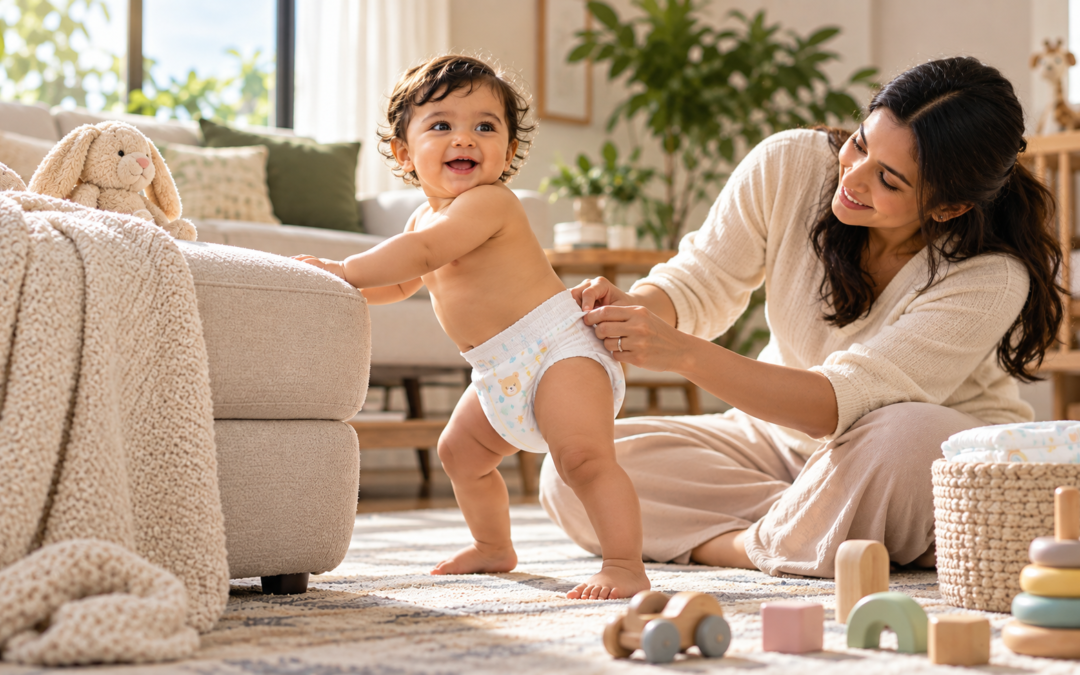
And this isn’t the only change coming. Once your baby becomes more mobile, diapering itself can become a different experience. A baby who once happily lay still may soon be rolling, crawling and trying to reach everything within sight.
That is when some parents begin considering pant style diapers because the pull-on design can be more convenient for a more active baby.
The important thing is not to rush through the stages. Your newborn doesn’t need the same diapering setup at three months that they needed during their first week.
8. What Changes by the End of the First 100 Days?
The biggest change may actually be you.
During those first few days, you probably think about every diaper change. You check whether the diaper is sitting correctly, make sure you have enough supplies and wonder whether you’re doing everything properly.
After doing it hundreds of times, the process becomes almost automatic.
You know which drawer the diapers are in. You know how many to pack for a short outing. You can tell when the current size is starting to feel too small. You know how your baby behaves when they need changing, and you have probably developed a nighttime routine that works reasonably well for both of you.
Your baby is changing too. They are becoming more alert and active, and the quiet newborn who stayed wherever you placed them will eventually start discovering that rolling around is much more interesting.
Later, when your baby is more mobile, pants style diapers for babies may become a convenient option for some families, particularly when traditional changes become harder to manage.
But you don’t need to figure all of that out on day one.
The first 100 days are about taking things as they come and adjusting when your baby does.
Takeaway
Nobody really masters newborn diapering in advance.
You learn it through repetition: one sleepy nighttime change, one unexpected leak, one nearly empty diaper pack and one “I definitely should have brought more diapers” outing at a time.
You learn to recognise your baby’s patterns rather than expecting every newborn to follow the same routine. You learn that fit matters more than simply choosing a diaper because it is labelled for a particular age. You learn that keeping supplies within reach can make an ordinary change much easier, especially when you are tired.
Most importantly, you learn that the routine will keep changing.
The diaper that works during the first few weeks may not be the one you want a few months later. The changing setup that seemed perfect before your baby could move may need to be rearranged once they start rolling. And the parent who once needed five minutes to prepare for a diaper change may eventually do the whole thing almost without thinking.
That’s what the first 100 days really give you.
Not a perfect routine.
Confidence that you know your baby a little better than you did yesterday.