Your baby has just been changed.
Fresh diaper. Fresh clothes. Maybe even a few minutes of peace.
Then suddenly, you hear that unmistakable little sound.
Pee.
You look down at the diaper and think, “Well, that was quick.”
But have you ever wondered what actually happens inside that diaper after the first few drops disappear?
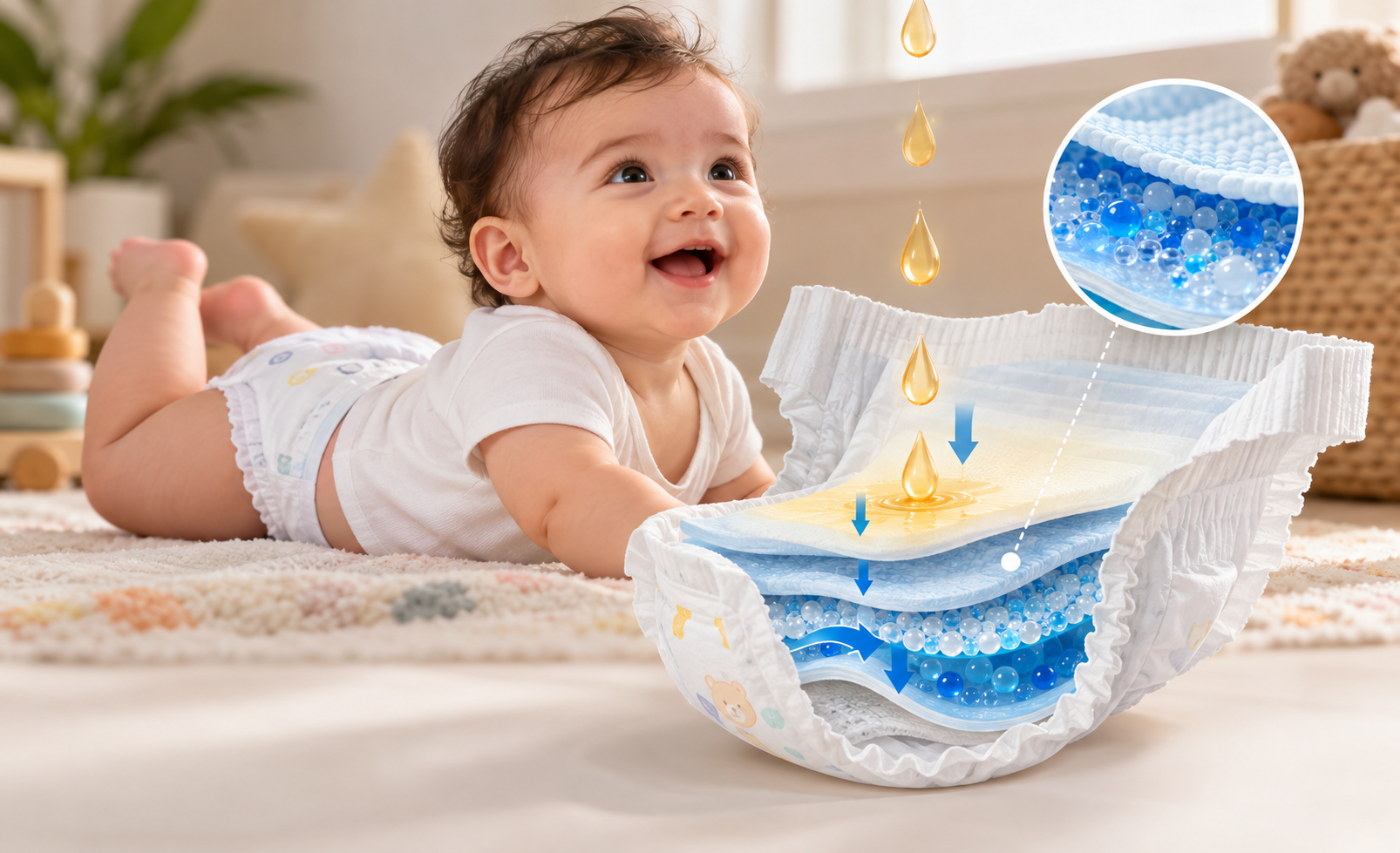
It is not simply sitting there like a tiny water balloon. A modern disposable diaper has several layers, each with a different job. One layer lets the liquid through, another helps move it around, and the absorbent core works to lock it away.
All of this happens while your baby continues kicking, sleeping, rolling around or attempting to crawl away from the next diaper change.
So let’s take a look inside.
In This Article
- The First Few Seconds After Your Baby Pees
- Why the Liquid Doesn’t Just Sit in One Place
- The Secret Ingredient Inside the Absorbent Core
- Why a Wet Diaper Can Still Feel Relatively Dry
- Then Your Baby Starts Moving
- When Absorbency Meets an Active Baby
- Why the Right Diaper Changes With Your Baby
- When Is a Wet Diaper Actually Full?
1. The First Few Seconds After Your Baby Pees
A diaper’s first job isn’t to hold everything.
It is to move the liquid away from where it just landed.
The soft layer against your baby’s skin allows urine to pass through into the layers underneath. From there, the liquid moves toward the absorbent core.
Think of it as a very tiny delivery system.
Your baby’s pee arrives.
The diaper says, “Not here.”
And sends it further inside.
That matters because keeping moisture directly against the skin is exactly what a well-designed diaper tries to avoid.
Your baby, meanwhile, is probably completely unconcerned about this sophisticated operation.
They have a toy to chew.
2. Why the Liquid Doesn’t Just Sit in One Place
Here’s something you might notice when you open a wet diaper.
The entire diaper does not necessarily feel equally wet.
That’s because the liquid is designed to move through the diaper rather than simply collecting exactly where it landed.
The layers underneath the inner surface help distribute the moisture through the absorbent area.
Why is that important?
Because babies are rarely stationary.
A newborn might be lying on their back one minute and kicking both legs the next. An older baby might be sitting, rolling, crawling, and somehow ending up underneath the coffee table before you have even finished putting the wipes away.
The diaper has to handle all that movement while still containing the liquid.
So it is not just about how much a diaper can absorb.
It is also about how efficiently it handles what gets inside.
3. The Secret Ingredient Inside the Absorbent Core
Now for the clever part.
Many disposable diapers contain a material called superabsorbent polymer.
You would not look at it and immediately think, “That is doing some serious work.”
But when it encounters liquid, it absorbs it and swells into a gel-like material, helping retain fluid inside the diaper.
In simple terms, the diaper is not just soaking up pee like a towel.
It captures and holds it inside the absorbent core.
That is why a diaper can get heavier without feeling like a pool of liquid sloshing around inside.
This happens every time your baby wets the diaper.
Quietly.
Repeatedly.
Without your baby having the slightest idea that clever material is working underneath them.
4. Why a Wet Diaper Can Still Feel Relatively Dry
This is probably the part parents appreciate most.
The diaper is wet.
But the surface against your baby’s skin does not necessarily feel like a wet cloth.
That is because the different layers are designed to move liquid away from the surface and into the absorbent core.
The liquid is supposed to travel down and in, rather than simply sitting on top.
Of course, that does not mean a wet diaper should stay on indefinitely.
As you add more liquid, the absorbent core gradually approaches capacity. The longer a diaper remains wet, the more important changing it becomes for comfort and hygiene.
Still, that initial separation between your baby’s skin and the absorbed liquid is one of the most important jobs happening inside the diaper.
And then comes the real challenge.
Your baby starts moving.
5. Then Your Baby Starts Moving
A newborn lying peacefully on their back is one thing.
A baby who has discovered rolling?
Different story.
A baby who has discovered crawling?
Good luck.
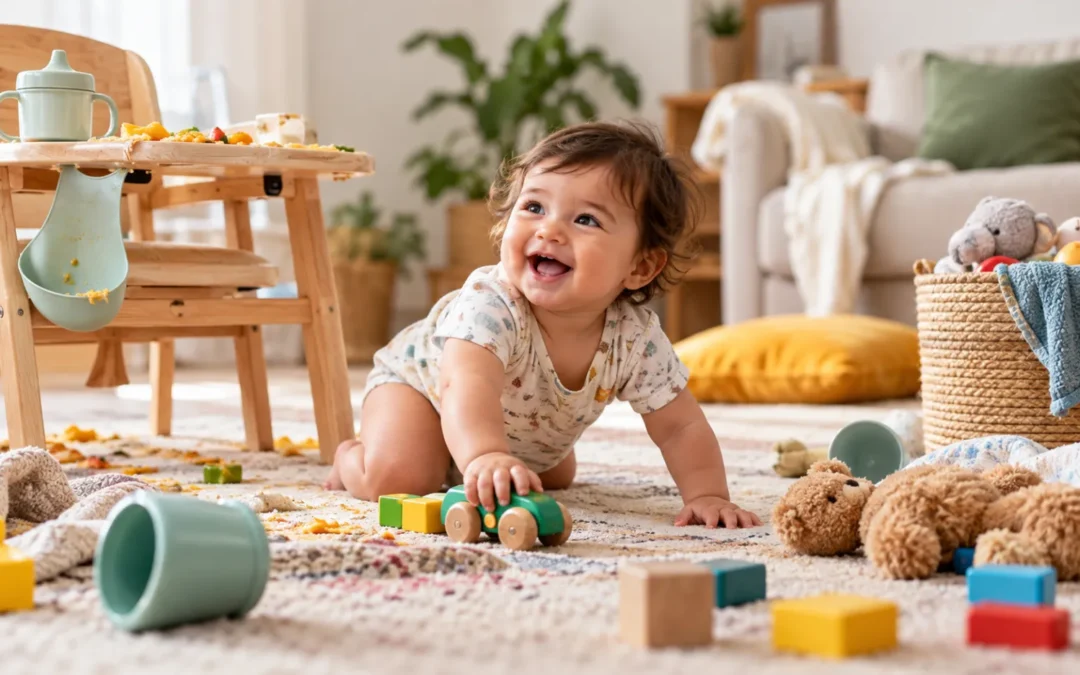
This is when diaper changes can become an unexpected workout.
- You put the clean diaper underneath.
- Your baby rolls.
- You bring them back.
- They kick.
- You reach for the wipes.
- They decide this is the perfect moment to escape.
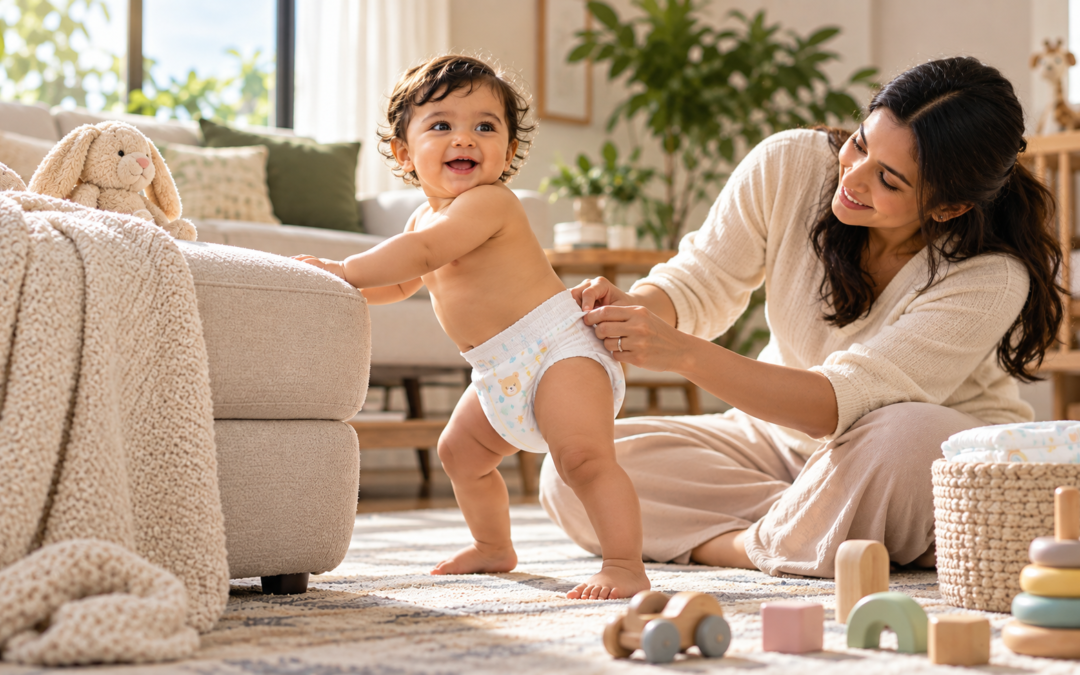
For more mobile babies, pant style diapers can be a practical option because their pull-on design can make changes easier when keeping a traditional diaper in place becomes increasingly difficult.
But movement creates another challenge.
The diaper needs to stay where it belongs.
Because even if the absorbent core is doing an excellent job, liquid can still escape if there are gaps around the legs or waist.
6. When Absorbency Meets an Active Baby
Imagine pouring water into a cup.
The cup might be perfectly capable of holding it.
But if you tilt the cup far enough, the water will find a way out.
A diaper faces a similar challenge when your baby is constantly changing position.
That is why leak proof diapers are not simply about having a highly absorbent center.
Fit matters too.
The waist needs to sit comfortably.
The leg openings need to provide a secure fit without being uncomfortably tight.
The diaper needs to stay in position when your baby rolls, crawls or sleeps.
And the size needs to match your baby’s current stage.
Sometimes parents assume a diaper is “not absorbent enough” when the real issue may be fit or positioning.
Your baby is changing quickly.
Their diaper needs to keep up.
7. Why the Right Diaper Changes With Your Baby
Newborn life has a very different rhythm.
- Sleep.
- Feed.
- Diaper change.
- Repeat.
When choosing diapers for newborn baby, parents often focus heavily on fit, softness, sizing, and comfort because a newborn’s body is so small and delicate.
Some newborn designs also include features around the front of the diaper to help accommodate the umbilical area.
But then something happens.
Your baby grows.
The sleepy newborn becomes a rolling baby.
The rolling baby becomes a crawling baby.
And suddenly, the diaper change that once took thirty seconds has become a negotiation.
That is where pants style diapers for babies can become useful for some families. The pull-on format is designed with a more active stage in mind and can make getting a diaper onto a moving baby considerably easier.
The point is not that one diaper style is right for every baby.
Your baby’s stage matters.
The diaper that worked perfectly last month may not be the most practical choice today.
8. When Is a Wet Diaper Actually Full?
Now for the question every parent eventually asks:
“How long can I leave this diaper on?”
No magic number works for every baby.
It depends on how much your baby has peed, the diaper’s absorbency, the fit, your baby’s age, and how comfortable the diaper remains.
If it feels heavily saturated, has started leaking, is visibly uncomfortable or simply needs changing, that is your cue.
Some diapers also have wetness indicators that make this easier by giving parents a visual signal when the diaper becomes wet.
But remember:
The goal is not to discover the maximum amount of pee a diaper can hold.
The goal is a comfortable, clean and dry-feeling baby.
Testing the diaper’s limits is not a parenting achievement.
So, Where Does the Pee Actually Go?
Let’s go back to that first question.
Your baby pees.
The liquid passes through the soft inner layer.
It moves into the layers underneath.
The absorbent core takes over.
Superabsorbent material absorbs and retains the liquid.
The outer layers help keep everything contained.
And meanwhile?
Your baby is probably smiling at you as if absolutely nothing happened.
That is what makes diaper design so interesting.
All of this happens without interrupting your baby’s day.
- They can sleep through it.
- They can crawl through it.
- They can kick through it.
- They can continue trying to grab your phone.
And the diaper quietly handles the mess in the background.
Takeaway
A diaper may look simple on the outside, but a lot is happening inside.
It has to move liquid away from the skin, distribute it through the absorbent area, retain it, and stay securely positioned while your baby moves.
And as your baby grows, the priorities change too.
Newborns need a comfortable, well-fitting design. More active babies may benefit from a pull-on format. Each stage brings its own mix of fit, absorbency, comfort, and convenience.
So the next time you change a wet diaper, remember:
It did not simply “catch the pee.”
It managed a whole little journey from the first drop to the final change.
All while your baby carried on with the much more important business of being a baby.